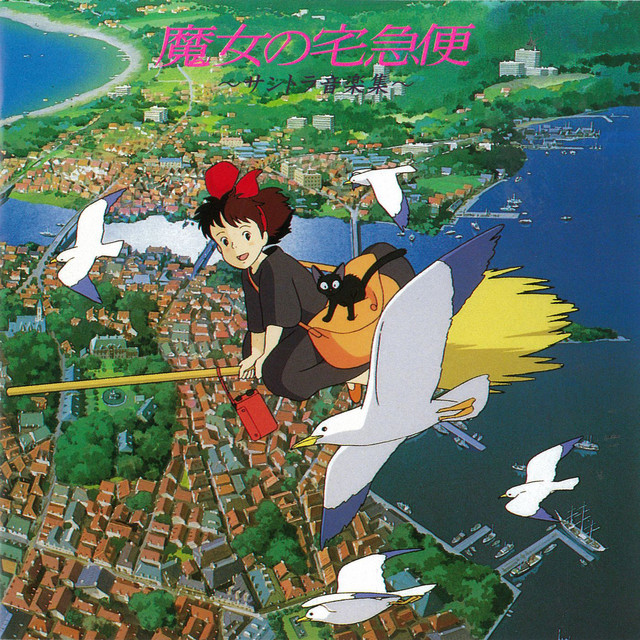
Album: 魔女の宅急便 サントラ音楽集
When Joe Hisaishi sat down to compose the soundtrack for Kiki’s Delivery Service in 1989, he faced an extraordinary challenge. With only days between returning from New York and recording with a full orchestra, the composer had to create music that would transport audiences to a fictional European town while maintaining the authentic spirit of continental folk traditions.
Among the most charming results of this intensive creative period is “Pan-ya no Tetsudai” (The Baker’s Helper), a delightful Continental Tango that serves as the unofficial theme for Osono, the kind-hearted baker who takes Kiki under her wing. This seemingly simple piece reveals the depth of Hisaishi’s approach to cultural authenticity and his ability to weave narrative meaning into musical fabric.
The track opens with the warm, breathy sound of an accordion, immediately establishing the European café atmosphere that Hisaishi sought throughout the album. Written in the Continental Tango style—a European interpretation of the Argentine dance form—the piece embodies the bustling energy of Osono’s bakery while maintaining an approachable, neighborly warmth. The three-quarter waltz rhythm that characterizes much of the Kiki soundtrack appears here transformed into something more commercially upbeat, reflecting the practical, business-minded nature of the bakery owner herself.
Hisaishi’s decision to center the arrangement around accordion wasn’t arbitrary. As part of his broader philosophy for the film, he deliberately reduced synthesizer usage in favor of acoustic instruments that could breathe life into the music—quite literally. The accordion, like the ocarinas and wood instruments featured throughout the score, requires the performer’s breath to create sound. This “wind-blown” quality serves multiple symbolic functions: representing the air currents that carry Kiki through her flying adventures, the atmosphere of the coastal town of Koriko, and most importantly, Kiki’s own life force as she navigates adolescence and independence.
The composer’s approach to European musical authenticity went far beyond surface-level mimicry. Rather than simply adopting familiar folk melodies, Hisaishi studied the structural and instrumental characteristics of Mediterranean and continental European music. For “Pan-ya no Tetsudai,” this meant incorporating the specific harmonic progressions and rhythmic patterns that make Continental Tango distinct from its South American cousin, while adding guitar and other traditional European instruments to create genuine textural authenticity.
What makes this piece particularly fascinating is how perfectly it captures Osono’s character without ever being explicitly labeled as her theme. The music’s generous, welcoming quality mirrors the baker’s immediate acceptance of the young witch, while the underlying commercial rhythm suggests her practical approach to life and business. The accordion’s capacity for both melody and harmony allows it to suggest the multifaceted nature of someone who can be both maternal figure and shrewd businesswoman.
The creation timeline for this music reveals the intensity of Hisaishi’s working method. After his New York recording session caused a month-long interruption in the Kiki project, he returned to Japan with barely weeks to complete additional compositions and orchestrations. The fact that he delivered such nuanced, culturally-informed music under these constraints speaks to both his technical mastery and his intuitive understanding of how music functions within narrative.
This compressed schedule also influenced the musical choices themselves. Rather than elaborate orchestral arrangements, Hisaishi focused on chamber-sized ensembles that could capture intimate, human-scaled emotions. “Pan-ya no Tetsudai” benefits from this approach, feeling like music that might actually emanate from a small-town European bakery rather than a concert hall.
The piece also demonstrates Hisaishi’s skill at creating music that works on multiple levels simultaneously. Children respond to its playful, bouncing quality, while adults can appreciate the sophisticated harmonic language and authentic folk music references. This dual accessibility became a hallmark of Hisaishi’s Studio Ghibli work, but it’s particularly evident in character pieces like this one.
Listening to “Pan-ya no Tetsudai” today, more than three decades after its creation, the music retains its fresh, welcoming quality. The accordion’s warm tones still evoke the smell of fresh bread and the comfort of finding kindness in unexpected places. In capturing both the specific character of Osono and the broader European cultural atmosphere that director Hayao Miyazaki envisioned, Hisaishi created a small but perfect example of how film music can transcend its functional purpose to become something genuinely meaningful in its own right.
The baker’s helper theme stands as proof that even under impossible deadlines, true musical craftsmanship can flourish when guided by clear artistic vision and deep cultural understanding.
- 晴れた日に…Read Review
- 旅立ち
- 海の見える街Read Review
- 空とぶ宅急便Read Review
- パン屋の手伝いNow Playing
- 仕事はじめRead Review
- 身代わりジジRead Review
- ジェフRead Review
- 大忙しのキキRead Review
- パーティーに間に合わないRead Review
- オソノさんのたのみ事…Read Review
- プロペラ自転車Read Review
- とべない!Read Review
- 傷心のキキRead Review
- ウルスラの小屋へRead Review
- 神秘なる絵Read Review
- 暴飛行の自由の冒険号Read Review
- おじいさんのデッキブラシRead Review
- デッキブラシでランデブーRead Review