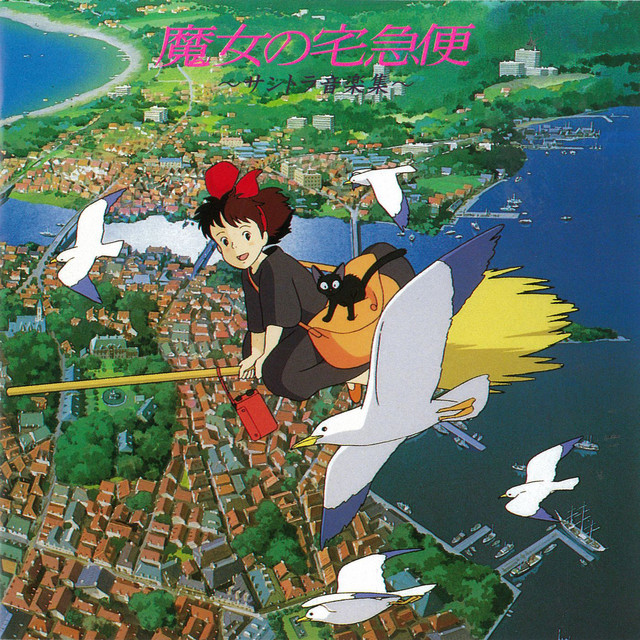
Album: 魔女の宅急便 サントラ音楽集
What happens when a composer must capture the exact moment childhood wonder lifts off the ground? For Joe Hisaishi, the answer came in three-quarter time with a distinctly rural European flavor in “Propeller Bicycle,” one of the most ingeniously structured pieces from his Kiki’s Delivery Service soundtrack.
The track serves as Tombo’s unofficial theme, accompanying the pivotal scene where he and Kiki race through town on his propeller-powered bicycle. But Hisaishi’s genius lies not in the melody itself, but in how the music literally transforms as their wheels leave the earth. What begins as an energetic chase sequence gradually accelerates in tempo, building anticipation until the moment of flight—when suddenly, the entire musical landscape shifts into what musicologist Hidekuni Maejima describes as a “rustic waltz.”
This transformation wasn’t accidental. Hisaishi deliberately crafted the piece to mirror the characters’ emotional journey from earthbound excitement to airborne wonder. The composer’s decision to shift into waltz time at the moment of flight creates an immediate sense of weightlessness, as if the music itself has been liberated from gravity’s constraints.
The rustic quality Maejima notes reflects Hisaishi’s broader compositional philosophy for this project. Abandoning his usual reliance on synthesizers, the composer instead embraced what he called “living sounds”—acoustic instruments that could breathe life into every frame. For the Kiki’s Delivery Service soundtrack, Hisaishi specifically sought European folk instruments like the dulcimer, guitar, and accordion to create what he described as a “Mediterranean flavor” with distinctly European ethnic and dance-like qualities.
This instrumental choice wasn’t merely aesthetic. Throughout the score, Hisaishi deliberately emphasized wind instruments—oboes, clarinets, flutes, ocarinas, and accordions—creating what amounts to a symphonic celebration of breath itself. In the world of Kiki, wind represents far more than weather; it symbolizes the very air that carries witches aloft, the atmospheric essence of Koriko town, and Kiki’s own vital life force. When Tombo’s bicycle takes flight in “Propeller Bicycle,” the shift to wind-driven waltz time becomes a musical embodiment of this philosophy.
The three-quarter time signature that dominates much of the Kiki soundtrack reflects Hisaishi’s fascination with European dance forms, but his application goes deeper than mere stylistic homage. Waltzes traditionally evoke elegance and sophistication, yet Hisaishi’s “rustic” interpretation strips away urban polish to reveal something more fundamental—the simple joy of movement itself. When Kiki and Tombo’s bicycle transforms into an airborne vehicle, the music doesn’t soar into grand orchestral heights. Instead, it settles into an earthier rhythm that suggests folk dancing in village squares rather than ballroom grandeur.
The creation of this piece occurred under almost impossibly tight constraints. Hisaishi’s schedule had been disrupted by a month-long recording session in New York, forcing him to complete additional compositions and arrangements in a matter of days after returning to Japan in June 1989. The full orchestra recording took place in early July, barely weeks before the film’s July 29th national release. Such pressure might have resulted in rushed, compromised music, but instead seems to have crystallized Hisaishi’s vision with remarkable clarity.
Perhaps this time constraint explains the piece’s elegant simplicity. Rather than overcomplicating the musical transformation, Hisaishi trusted in the power of rhythmic shift and instrumental color to convey the scene’s emotional arc. The propeller bicycle’s mechanical rhythm gives way to organic waltz flow, suggesting that true flight requires not just mechanical innovation but a surrender to natural forces.
This philosophical depth distinguishes “Propeller Bicycle” from typical animated film scores. While many composers might have emphasized the mechanical aspects of Tombo’s invention or created purely whimsical music for the flight sequence, Hisaishi instead crafted a piece that reflects his understanding of flight as both literal and metaphorical liberation. The rustic waltz represents not technological triumph but the discovery of grace within simplicity.
The track’s genius ultimately lies in its recognition that the most profound transformations often happen quietly. When Kiki and Tombo rise above their everyday world, they don’t need triumphant fanfares or soaring melodies. They need only the simple, eternal rhythm of three-quarter time and the breath of acoustic instruments to remind us that some of life’s greatest magic happens not in grand gestures, but in moments when we remember how to play.
- 晴れた日に…Read Review
- 旅立ち
- 海の見える街Read Review
- 空とぶ宅急便Read Review
- パン屋の手伝いRead Review
- 仕事はじめRead Review
- 身代わりジジRead Review
- ジェフRead Review
- 大忙しのキキRead Review
- パーティーに間に合わないRead Review
- オソノさんのたのみ事…Read Review
- プロペラ自転車Now Playing
- とべない!Read Review
- 傷心のキキRead Review
- ウルスラの小屋へRead Review
- 神秘なる絵Read Review
- 暴飛行の自由の冒険号Read Review
- おじいさんのデッキブラシRead Review
- デッキブラシでランデブーRead Review