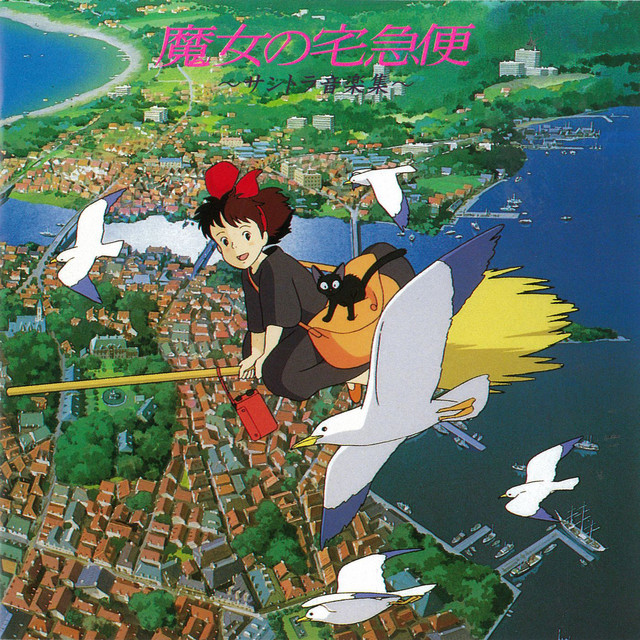
Album: 魔女の宅急便 サントラ音楽集
In the sunlit world of Kiki’s Delivery Service, where cobblestone streets echo with accordion melodies and the Mediterranean breeze carries hope on its wings, there exists one moment of profound darkness. Among Joe Hisaishi’s predominantly major-key soundtrack, ‘Kiki’s Heartbreak’ (Shoushin no Kiki) stands as the sole minor-key composition—a musical island of melancholy in an ocean of optimism.
This singular piece of music represents far more than just a sad song in a cheerful film. It embodies Hisaishi’s sophisticated understanding of emotional architecture and his ability to create unity through contrast. The composer, known for his meticulous attention to musical storytelling, deliberately chose to isolate this moment of despair, making it all the more powerful through its rarity.
The creation of this soundtrack occurred under extraordinary pressure. Hisaishi found himself in a scheduling nightmare when his New York recording sessions overlapped with the film’s production timeline, forcing a month-long work stoppage. Upon returning to Japan in June, he faced an impossible deadline: complete additional compositions and arrangements, conduct full orchestra recordings by early July, and deliver everything before the film’s July 29 national release. In today’s film industry, such a timeline would be considered reckless, yet Hisaishi thrived under this pressure.
During those frantic weeks, Hisaishi made a crucial artistic decision that would define the entire soundtrack’s character. Rather than rely on synthesizers, which had become increasingly common in film scoring, he chose to embrace organic, acoustic instruments. This wasn’t merely an aesthetic choice—it was philosophical. As Kiki’s story demanded realism and emotional authenticity, Hisaishi believed the music should reflect that same honesty through natural sounds.
The composer’s European inspiration permeates every track, with Mediterranean dance rhythms and three-four time signatures creating a cohesive cultural atmosphere. He incorporated traditional instruments like the dulcimer—a hammered string instrument that predates the piano—alongside guitars and accordions to evoke the Old World charm of Kiki’s fictional town. These choices weren’t arbitrary; they were part of Hisaishi’s larger vision to create what he called ‘European ethnic dance-style music.’
Yet within this carefully constructed sonic landscape, ‘Kiki’s Heartbreak’ serves a unique purpose. The track begins in haunting minor tonality, reflecting the young witch’s moment of deepest despair when her powers begin to fade. The melody carries weight and uncertainty, a stark contrast to the buoyant themes that characterize most of the score. However, Hisaishi’s genius reveals itself in the song’s evolution—as accordion and mandolin enter during the latter half, they gradually restore the musical connection to the film’s broader harmonic world.
This structural decision reflects Hisaishi’s deep understanding of musical psychology. By allowing traditional European folk instruments to emerge from the darkness, he suggests that even in our lowest moments, the community and culture that sustain us remain present, ready to lift us back toward the light. The accordion, in particular, carries symbolic weight throughout the entire soundtrack as one of many wind instruments that Hisaishi employed strategically.
The prevalence of breath-powered instruments—ocarinas, accordions, and various woodwinds—wasn’t coincidental. These instruments literally depend on air and breath to create sound, mirroring the wind that carries Kiki through the sky. More profoundly, breath represents life force itself, the vital energy that allows the young witch to maintain her magical abilities. When Kiki loses confidence, symbolically losing her breath and life force, the music reflects this through its minor harmonies.
Hisaishi’s compositional approach during this project revealed his evolution as an artist moving away from electronic convenience toward acoustic authenticity. The decision to minimize synthesizers forced him to think more deeply about instrumental color and emotional texture. Each instrument choice became more deliberate, more meaningful.
The time pressure that might have compromised another composer’s work seemed to focus Hisaishi’s creative instincts. Perhaps the urgency prevented overthinking, allowing his intuitive understanding of the story to guide his musical decisions. The result was a soundtrack that feels both carefully planned and spontaneously emotional.
‘Kiki’s Heartbreak’ ultimately serves as the emotional fulcrum of the entire musical experience. Its minor-key isolation makes the surrounding major-key celebrations more joyful, while its gradual harmonic resolution toward the film’s established musical language suggests that sadness, while real and necessary, need not be permanent. In Hisaishi’s musical world, even heartbreak contains within it the seeds of recovery, carried on the breath of community and the wind of hope.
- 晴れた日に…Read Review
- 旅立ち
- 海の見える街Read Review
- 空とぶ宅急便Read Review
- パン屋の手伝いRead Review
- 仕事はじめRead Review
- 身代わりジジRead Review
- ジェフRead Review
- 大忙しのキキRead Review
- パーティーに間に合わないRead Review
- オソノさんのたのみ事…Read Review
- プロペラ自転車Read Review
- とべない!Read Review
- 傷心のキキNow Playing
- ウルスラの小屋へRead Review
- 神秘なる絵Read Review
- 暴飛行の自由の冒険号Read Review
- おじいさんのデッキブラシRead Review
- デッキブラシでランデブーRead Review