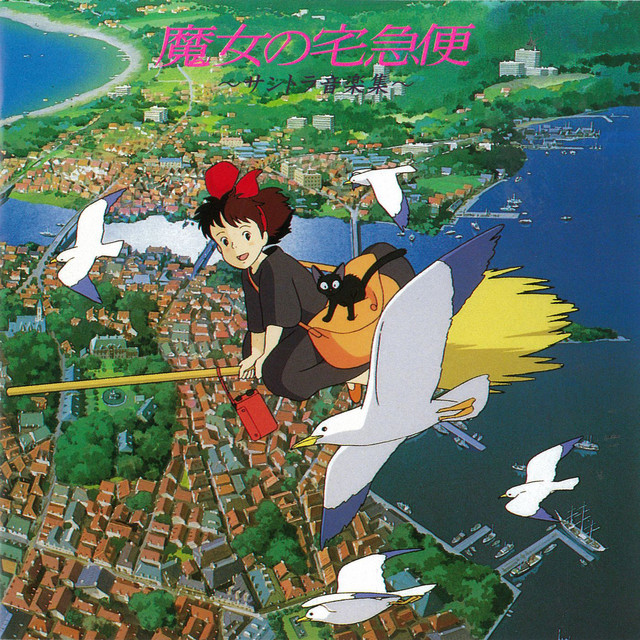
Album: 魔女の宅急便 サントラ音楽集
In the bustling world of Studio Ghibli’s ‘Kiki’s Delivery Service,’ where young witches soar through European skies and magic fills every corner, there exists a quieter moment of pure musical poetry. Joe Hisaishi’s track ‘Jeff’ captures something most film composers overlook: the unhurried dignity of an aging dog. Through the gentle voice of a tuba, Hisaishi paints an audio portrait that reveals as much about his compositional philosophy as it does about a sleepy canine character.
The choice of tuba as Jeff’s musical voice speaks volumes about Hisaishi’s understanding of character through sound. Where many composers might reach for strings or woodwinds to convey warmth, Hisaishi selected an instrument often relegated to comic relief or foundational support. The tuba’s naturally relaxed articulation and warm, breathy tone becomes the perfect vessel for expressing Jeff’s slow, measured movements and gentle temperament. Each phrase seems to lumber forward with the same unhurried pace as an old dog finding his favorite sunny spot for an afternoon nap.
This creative choice emerged from a particularly intense period in Hisaishi’s career. The composer found himself caught between two worlds when his New York recording sessions collided with the Ghibli project timeline. For an entire month, work on the ‘Kiki’s Delivery Service’ soundtrack ground to a halt. When Hisaishi finally returned to Japan, he faced what would be considered impossible by today’s standards: complete the remaining compositions and arrangements, then record with a full orchestra, all within weeks of the film’s nationwide release.
Yet this pressure cooker environment may have actually sharpened Hisaishi’s focus. The composer made a conscious decision to move away from the synthesizer-heavy approach that had marked some of his earlier work. Instead, he embraced what he called ‘living sounds’ – acoustic instruments that breathed life into every note. This shift toward organic instrumentation perfectly aligned with the film’s grounded, real-world setting, even within its magical context.
‘Jeff’ exemplifies this philosophy beautifully. The track unfolds in a leisurely tempo that mirrors the old dog’s unhurried gait, with the tuba carrying the main melodic line in a way that feels both conversational and contemplative. But Hisaishi’s genius lies in the details: midway through the piece, the familiar waltz theme from the film’s main score appears, reimagined through the lens of a military band arrangement. This transformation serves multiple narrative purposes – it connects Jeff’s quiet world to the broader magical universe of the film while suggesting the dog’s own rich history.
The composer’s European inspiration runs deep throughout the soundtrack, and ‘Jeff’ participates in this Continental atmosphere through its use of folk-influenced harmonies and rhythmic patterns. Hisaishi deliberately incorporated instruments like the dulcimer, guitar, and accordion to evoke what he described as ‘European ethnic and dance-like qualities.’ While ‘Jeff’ may not feature these instruments prominently, it shares their approach to melody and phrasing – unhurried, folk-like, and deeply rooted in traditional musical storytelling.
Perhaps most significantly, ‘Jeff’ demonstrates Hisaishi’s broader philosophy about wind instruments throughout the ‘Kiki’s Delivery Service’ score. The composer filled his orchestration with instruments that require breath – ocarinas, accordions, woodwinds, and yes, the tuba. This wasn’t mere coincidence but deliberate symbolism. Breath represents wind, and wind represents the very force that carries Kiki through the sky. It symbolizes the air that fills the streets of the fictional European town of Koriko, and ultimately, it represents life force itself.
In Jeff’s musical portrait, the tuba’s breath becomes the old dog’s own gentle breathing – steady, warm, and utterly alive. Each musical phrase rises and falls like the rhythm of sleep, creating an audio environment so convincing you can almost see Jeff’s chest rising and falling in the afternoon sun.
This attention to character through instrumental choice reveals Hisaishi’s deep understanding of how music functions in animation. Unlike live-action films where actors provide emotional context, animated characters depend entirely on visual design and musical characterization to achieve psychological depth. Jeff may only appear briefly in the film, but through Hisaishi’s tuba-led composition, the old dog gains a complete emotional landscape.
The remarkable thing about ‘Jeff’ is how it manages to be both utterly specific – this is clearly the musical DNA of one particular sleepy dog – and universally recognizable. Anyone who has ever loved an aging pet will hear something familiar in those unhurried tuba phrases. Hisaishi achieved what all great character composers strive for: music that doesn’t just accompany the image but becomes inseparable from our understanding of who that character truly is.
In a soundtrack filled with soaring themes and magical moments, ‘Jeff’ reminds us that sometimes the most profound music walks on four paws, breathing slowly, content to exist in the spaces between the grand gestures. Through a few minutes of thoughtful orchestration, Joe Hisaishi created not just a piece of film music, but a small monument to the quiet dignity of growing old gracefully.
- 晴れた日に…Read Review
- 旅立ち
- 海の見える街Read Review
- 空とぶ宅急便Read Review
- パン屋の手伝いRead Review
- 仕事はじめRead Review
- 身代わりジジRead Review
- ジェフNow Playing
- 大忙しのキキRead Review
- パーティーに間に合わないRead Review
- オソノさんのたのみ事…Read Review
- プロペラ自転車Read Review
- とべない!Read Review
- 傷心のキキRead Review
- ウルスラの小屋へRead Review
- 神秘なる絵Read Review
- 暴飛行の自由の冒険号Read Review
- おじいさんのデッキブラシRead Review
- デッキブラシでランデブーRead Review