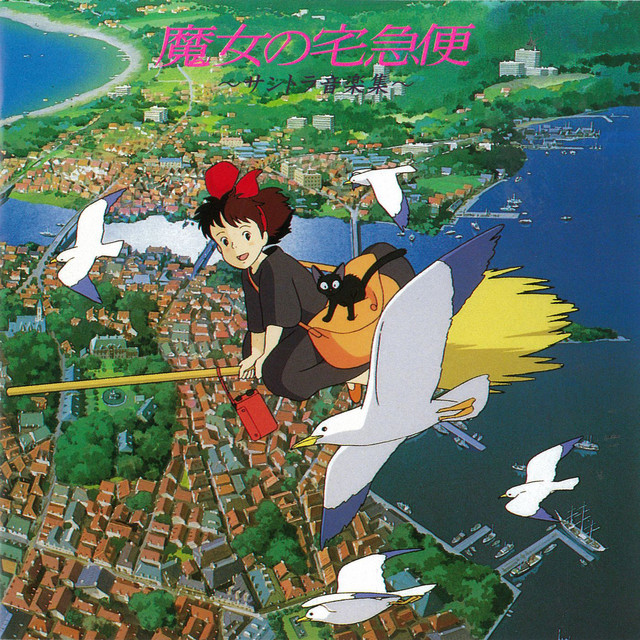
Album: 魔女の宅急便 サントラ音楽集
In the summer of 1989, composer Joe Hisaishi faced an impossible deadline. Fresh off a plane from New York, he had just two days to prepare for recording sessions that would complete one of Studio Ghibli’s most beloved soundtracks. Among the pieces he crafted during this whirlwind period was ‘Shigoto Hajime’ (Work Begins), a track that perfectly encapsulates the European-inspired musical philosophy behind Kiki’s Delivery Service.
The song serves as more than just background music—it’s a sonic representation of young Kiki’s determined spirit as she begins her new life as an independent witch in the coastal town of Koriko. Hisaishi’s approach to this piece reflects a fascinating creative decision that shaped the entire soundtrack: abandoning the synthesizer-heavy arrangements of his earlier works in favor of authentic European folk instruments.
‘The content became more realistic, so I moved the overall sound closer to live instruments,’ Hisaishi explained of his compositional strategy. This shift toward organic instrumentation is immediately apparent in ‘Shigoto Hajime,’ where the dulcimer—a hammered string instrument considered a predecessor to the piano—takes center stage alongside guitars and accordion. These choices weren’t arbitrary; they were carefully selected to evoke the Mediterranean atmosphere that director Hayao Miyazaki envisioned for Koriko.
The track’s lilting 3/4 time signature exemplifies another key element of Hisaishi’s approach: the incorporation of European dance rhythms. Rather than relying on complex orchestral arrangements, he drew inspiration from folk traditions, creating music that feels both celebratory and grounded. This waltz-like meter gives ‘Shigoto Hajime’ an almost festive quality, perfectly matching Kiki’s mixture of nervousness and excitement as she embarks on her entrepreneurial journey.
What makes this piece particularly striking is Hisaishi’s strategic use of wind instruments throughout the arrangement. Wooden flutes, ocarinas, and the accordion’s bellows-driven sound all require breath—a creative choice that extends far beyond mere instrumentation. For Hisaishi and the Ghibli team, breath represented wind, and wind symbolized multiple layers of meaning: the air currents that allow Kiki to fly, the atmospheric essence of her new seaside home, and most importantly, her own life force and determination.
This philosophical approach to instrumentation reveals the deeper collaborative relationship between Hisaishi and the film’s producers. Hayao Miyazaki and Isao Takahata had made a specific request that would challenge conventional film scoring wisdom: eliminate minor keys entirely. ‘Since we’re depicting a girl’s journey toward independence and growth, we wanted to avoid melancholic music as much as possible and use only bright music,’ Hisaishi recalled.
For a composer accustomed to exploring emotional complexity through harmonic sophistication, this constraint could have been limiting. Instead, Hisaishi found liberation in major tonalities, crafting pieces like ‘Shigoto Hajime’ that maintain emotional depth while radiating optimism. The song’s bright harmonic progressions mirror Kiki’s resilient spirit, even when she faces the inevitable challenges of starting a delivery service with only a broomstick and determination.
The creation of this track occurred under extraordinary pressure. Hisaishi’s work schedule had been disrupted by a month-long recording session in New York, forcing him to complete additional compositions and orchestrations in a matter of days upon his return to Japan. The full orchestra recording sessions in early July represented a frantic race against time, as the film’s nationwide release was scheduled for July 29, 1989.
Modern film production would never tolerate such compressed timelines, yet this urgency may have contributed to the soundtrack’s spontaneous energy. ‘Shigoto Hajime’ feels immediate and alive, capturing the same improvisational spirit that defines Kiki’s approach to building her business. There’s an entrepreneurial quality to both the character’s journey and the composer’s creative process—making do with limited time and resources while maintaining artistic integrity.
The track’s Mediterranean influences extend beyond instrumentation to its melodic structure. Hisaishi incorporated what he described as ‘Mediterranean-style melodies,’ drawing from the modal scales and ornamental phrases characteristic of Greek and Southern European folk music. These elements give ‘Shigoto Hajime’ a distinctive character that sets it apart from typical Japanese film music of the era.
Listening to the piece today, more than three decades after its creation, reveals the prescience of Hisaishi’s artistic choices. By grounding his score in authentic folk traditions rather than contemporary synthesizer technology, he created music that feels timeless rather than dated. ‘Shigoto Hajime’ continues to evoke the same sense of possibility and adventure that made Kiki’s story resonate with audiences worldwide.
The song ultimately represents a convergence of practical constraints and creative vision. Born from tight deadlines, shaped by directorial guidance, and realized through careful instrumental choices, it demonstrates how limitations can inspire rather than inhibit artistic expression. In just a few minutes of music, Hisaishi captured the essence of beginning again—whether as a young witch starting her first job or a composer discovering new sonic territories in the span of two remarkable days.
- 晴れた日に…Read Review
- 旅立ち
- 海の見える街Read Review
- 空とぶ宅急便Read Review
- パン屋の手伝いRead Review
- 仕事はじめNow Playing
- 身代わりジジRead Review
- ジェフRead Review
- 大忙しのキキRead Review
- パーティーに間に合わないRead Review
- オソノさんのたのみ事…Read Review
- プロペラ自転車Read Review
- とべない!Read Review
- 傷心のキキRead Review
- ウルスラの小屋へRead Review
- 神秘なる絵Read Review
- 暴飛行の自由の冒険号Read Review
- おじいさんのデッキブラシRead Review
- デッキブラシでランデブーRead Review