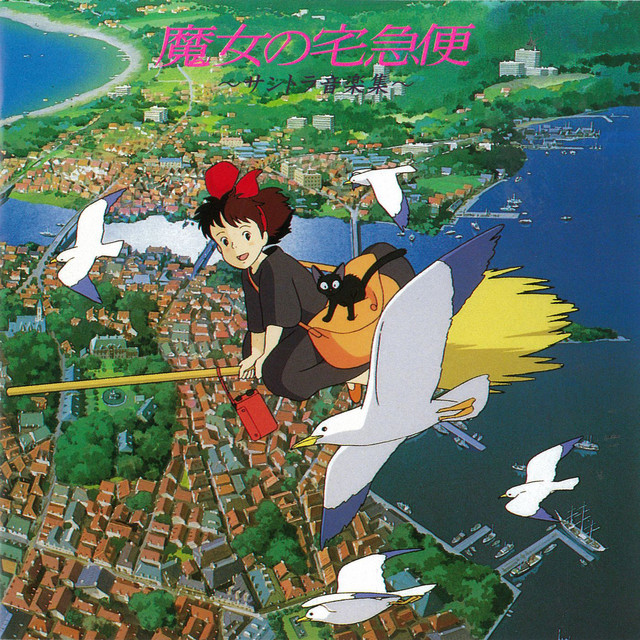
Album: 魔女の宅急便 サントラ音楽集
Deep within the enchanting world of Kiki’s Delivery Service lies a musical secret that never made it to the silver screen—a track so bold and thrilling it could have transformed our entire perception of the beloved witch’s adventure. ‘Grandpa’s Deck Brush’ (おじいさんのデッキブラシ) stands as one of Joe Hisaishi’s most fascinating creative experiments, a piece that dares to reimagine Studio Ghibli’s gentle magic through the lens of international espionage.
Originally composed for an action sequence where Kiki rescues Tombo from an airship, this unused cue takes the beloved ‘A Town with an Ocean View’ theme and transforms it into something entirely unexpected—a full-blown spy thriller arrangement that wouldn’t feel out of place in a 007 film. The transformation is nothing short of remarkable: where the original theme evokes peaceful European coastal towns, this version pulses with urgent brass, driving percussion, and the kind of orchestral swagger that typically accompanies high-stakes chase scenes.
The story behind this track reveals much about Hisaishi’s creative process during one of the most pressured periods of his career. Working under what can only be described as impossible circumstances, the composer faced a month-long interruption due to overlapping recording sessions in New York. Upon returning to Japan, he had mere days to complete additional compositions and arrangements before full orchestra recording in early July—all to meet the film’s July 29th nationwide release.
Yet even under such extreme time constraints, Hisaishi’s attention to musical philosophy remained unwavering. For Kiki’s Delivery Service, he had committed to reducing synthesizer usage dramatically, seeking what he called ‘sounds closer to life.’ This decision wasn’t merely aesthetic; it reflected the film’s more realistic approach compared to previous Ghibli works. The European atmosphere he sought to create demanded authentic instrumental voices—dulcimer, guitar, accordion, and other instruments that could genuinely evoke the Mediterranean coastal setting.
‘Grandpa’s Deck Brush’ exemplifies this philosophy perfectly. Despite its spy-thriller energy, the arrangement maintains the European folk sensibilities that define the entire soundtrack. The three-quarter time signatures that characterize much of the score appear even here, creating an unusual hybrid—a waltz-time action sequence that feels both urgent and graceful. This rhythmic choice reflects Hisaishi’s broader use of European dance forms throughout the album, lending even the most dramatic moments a sense of cultural authenticity.
The instrumentation choices reveal another layer of Hisaishi’s thoughtful approach. Wind instruments—those that require breath, the very essence of life—dominate the orchestration. Ocarina, accordion, and various woodwinds carry melodic responsibilities, embodying what music analyst Hidekuni Maeshima identifies as symbols of Kiki’s flying wind, Koriko’s atmospheric essence, and the young witch’s own vital energy. In this unused track, these breath-powered instruments take on additional significance, suggesting that even in moments of high drama, Kiki’s life force remains the driving energy.
The decision to ultimately cut this piece from the final film speaks to the delicate balance required in animated storytelling. While ‘Grandpa’s Deck Brush’ stands as perhaps the most musically compelling track on the entire soundtrack, its James Bond-inspired intensity might have overwhelmed the gentler emotional arc that director Hayao Miyazaki envisioned. The spy-thriller aesthetic, however expertly crafted, could have shifted audience perception of Kiki’s world from magical realism toward something more conventionally adventurous.
Listening to this track today offers a fascinating glimpse into an alternate version of Kiki’s story—one where the stakes feel higher, the dangers more immediate, and the young witch’s heroism more explicitly cinematic. The brass sections surge with Hollywood-caliber intensity, while the underlying European folk elements prevent the music from abandoning its cultural roots entirely. It’s a masterclass in genre blending that few composers could execute so convincingly.
The existence of ‘Grandpa’s Deck Brush’ also illuminates Hisaishi’s remarkable versatility as a composer. Known primarily for his ability to capture wonder and innocence, this track proves his equal facility with tension and excitement. The seamless transformation of the peaceful ‘Ocean View’ theme into spy-thriller territory demonstrates not just technical skill, but deep understanding of how musical elements can be repurposed to serve entirely different emotional purposes.
Perhaps most intriguingly, this unused cue suggests questions about the paths not taken in animated film scoring. What if Studio Ghibli films embraced more conventional action-adventure elements? How might audiences have responded to a more thriller-oriented approach to fantastical storytelling? While we’ll never know these answers definitively, ‘Grandpa’s Deck Brush’ provides a tantalizing musical glimpse into these alternate possibilities.
For Hisaishi scholars and Studio Ghibli enthusiasts, this track represents something precious—evidence of creative risk-taking even within the constraints of commercial animation. It stands as proof that behind every gentle Ghibli moment lies the potential for something entirely different, something bold enough to transform witches into secret agents and deck brushes into instruments of international intrigue.
- 晴れた日に…Read Review
- 旅立ち
- 海の見える街Read Review
- 空とぶ宅急便Read Review
- パン屋の手伝いRead Review
- 仕事はじめRead Review
- 身代わりジジRead Review
- ジェフRead Review
- 大忙しのキキRead Review
- パーティーに間に合わないRead Review
- オソノさんのたのみ事…Read Review
- プロペラ自転車Read Review
- とべない!Read Review
- 傷心のキキRead Review
- ウルスラの小屋へRead Review
- 神秘なる絵Read Review
- 暴飛行の自由の冒険号Read Review
- おじいさんのデッキブラシNow Playing
- デッキブラシでランデブーRead Review