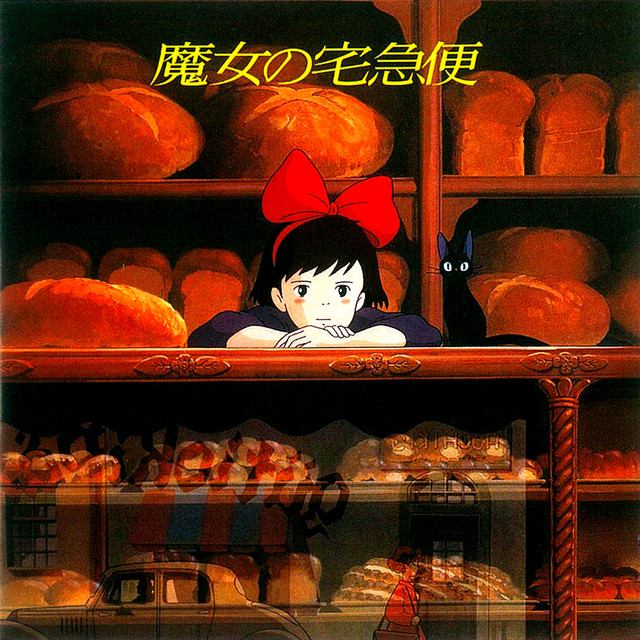
Album: 魔女の宅急便 イメージアルバム
In the world of film composition, few collaborations have been as fruitful as the partnership between director Hayao Miyazaki and composer Joe Hisaishi. Yet perhaps nowhere is this creative synergy more apparent than in Hisaishi’s work on “Kiki’s Delivery Service,” particularly in the image album that preceded the final soundtrack. Among these preliminary musical sketches sits “Komorebi no Roji” (Dappled Light Alley), a piece that perfectly encapsulates Hisaishi’s unique approach to scoring animated films.
The creation of “Komorebi no Roji” was part of an unusual process that would become a hallmark of Studio Ghibli productions. Rather than composing music after the film was completed, Hisaishi worked closely with Miyazaki during the early stages of production, creating what he called an “image album” – essentially musical storyboards that would guide both the animation and the final score. This collaborative approach was so precise that nearly every track from the image album found its way into the finished film, with only two pieces left unused.
Set in a dreamy European landscape that Hisaishi described as “somewhere vaguely European, perhaps Mediterranean,” “Komorebi no Roji” embodies the composer’s ability to create atmosphere through deceptively simple means. The track is built around a synthesizer foundation, but it’s the subtle additions of violin, guitar, and light percussion that give it its distinctly European flavor. The melody itself moves in a gentle 4/4 tempo, allowing each phrase to breathe naturally, much like the dappled sunlight filtering through leaves that the title evokes.
What makes this piece particularly fascinating is how it demonstrates Hisaishi’s philosophy of musical sketching. Unlike the fully orchestrated versions that would appear in the final soundtrack, “Komorebi no Roji” remains intentionally unpolished, with its synthesizer-heavy arrangement serving as a kind of musical rough draft. Yet far from feeling incomplete, this simplicity allows the melody to shine through with remarkable clarity. It’s as if Hisaishi understood that sometimes the most powerful musical ideas are also the most direct ones.
The choice of instrumentation in both the image album version and its eventual film incarnation reveals deeper artistic intentions. Hisaishi and Miyazaki made a conscious decision to emphasize wind instruments throughout the score – ocarina, accordion, woodwinds – instruments that require breath to create sound. This wasn’t merely an aesthetic choice but a symbolic one. The breath that brings these instruments to life represents the wind that carries Kiki through the sky, the atmosphere of the coastal town of Koriko, and ultimately, Kiki’s own life force.
In “Komorebi no Roji,” this philosophy manifests in the gentle interplay between the synthetic foundation and the more organic instrumental voices that dance above it. The piece captures that magical moment when sunlight breaks through tree branches, creating shifting patterns of light and shadow – a perfect metaphor for the way music can illuminate the emotional landscape of a scene.
The collaborative nature of this creative process extended beyond just Miyazaki and Hisaishi. Producer Isao Takahata’s influence can be felt in the decision to incorporate contemporary elements alongside the more fantastical musical themes. His choice to include Yumi Matsutoya’s “Wrapped in Tenderness” as a radio song in the film reflects a desire to ground the magical story in recognizable reality – a philosophy that Hisaishi echoed in his own compositions by balancing the ethereal with the familiar.
What emerges from “Komorebi no Roji” is a perfect example of Hisaishi’s unique gift for creating music that feels both timeless and immediate. The track’s Mediterranean influences give it a sense of old-world charm, while its synthesizer core keeps it firmly planted in the present. This duality mirrors the film itself, which tells an ancient story of magic and coming-of-age through thoroughly modern animation techniques.
Listening to “Komorebi no Roji” today, one can hear the seeds of the entire Kiki’s Delivery Service soundtrack. Its gentle optimism, its careful balance of synthetic and acoustic elements, and its ability to evoke specific imagery through pure musical means all became defining characteristics of the final score. Yet the image album version retains something that the more polished soundtrack versions sometimes lose – a sense of spontaneity and discovery that comes from music created in the moment of inspiration.
This approach to film scoring – treating preliminary compositions as legitimate artistic statements rather than mere stepping stones – has influenced countless composers in the decades since. Hisaishi’s image albums have become sought-after recordings in their own right, prized by fans who appreciate their intimate, sketch-like quality.
“Komorebi no Roji” stands as a beautiful example of how the most profound musical statements often come not from grand orchestral gestures but from simple melodies that capture the essence of a moment, a feeling, or in this case, the play of light through leaves on a quiet European afternoon.
- かあさんのホウキRead Review
- ナンパ通りRead Review
- 町の夜Read Review
- 元気になれそうRead Review
- 渚のデイトRead Review
- 風の丘Read Review
- トンボさんRead Review
- リリーとジジRead Review
- 世界って広いわRead Review
- パン屋さんの窓Read Review
- 突風Read Review
- 木洩れ陽の路地Now Playing