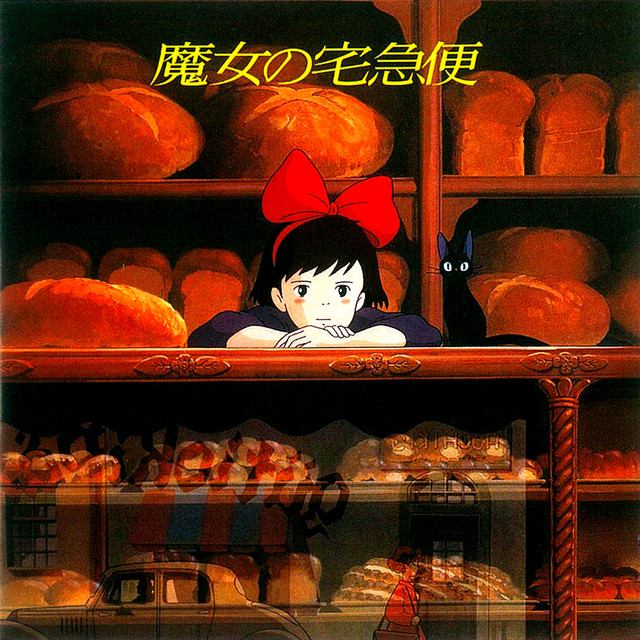
Album: 魔女の宅急便 イメージアルバム
Among the rare unused tracks from Joe Hisaishi’s ‘Kiki’s Delivery Service Image Album’ sits a fascinating musical artifact called ‘Toppuu’ (突風), which translates to ‘Sudden Gust of Wind.’ This piece offers a unique window into Hisaishi’s creative process and the collaborative relationship that shaped one of Studio Ghibli’s most beloved soundscapes.
The story behind ‘Toppuu’ begins with an extraordinary scheduling conflict that would test even the most seasoned composer. In the late 1980s, Hisaishi found himself juggling two monumental projects: recording his solo album in New York and composing the soundtrack for Hayao Miyazaki’s upcoming film about a young witch learning to fly. When these timelines collided, it forced an innovative approach that would ultimately define the creative process for the entire project.
Facing this time crunch, directors Hayao Miyazaki and Isao Takahata stepped in to create a detailed plan mapping specific scenes to musical requirements. This wasn’t just practical problem-solving; it was the foundation for one of the most meticulously planned film scores in animation history. Hisaishi would compose based on these visual blueprints, creating what he called ‘rough sketch music’ – raw, unpolished gems that captured the essence of each intended scene.
‘Toppuu’ emerged from this process as part of the Image Album, a collection that preceded the final soundtrack by several months. These tracks were conceived while Hisaishi imagined ‘something vaguely European, somewhere around the Mediterranean.’ The Mediterranean influence permeates the album through its choice of instruments – synthesizers providing the foundation while violins, guitars, and percussion add distinctly European flavors.
The track itself embodies the album’s synthesizer-driven aesthetic, built around simple arrangements that allow Hisaishi’s melodic sensibilities to shine through unencumbered by heavy orchestration. In ‘Toppuu,’ the composer creates a sense of sudden, swirling motion through ascending synthesizer lines and rhythmic patterns that mirror the unpredictable nature of a gust of wind. The piece moves in a moderate tempo, allowing space for the wind metaphor to develop through rising and falling melodic phrases.
What makes ‘Toppuu’ particularly intriguing is its relationship to the film’s broader musical philosophy. Throughout the final soundtrack, Hisaishi would employ wind instruments – ocarinas, accordions, and woodwinds – as symbols of breath, life, and Kiki’s connection to the sky. Music critic Hidekuni Maejima noted how these ‘breath-powered’ instruments represented not just the wind that carries Kiki through her flights, but the atmospheric essence of Koriko town and Kiki’s own vital energy.
‘Toppuu,’ despite being unused in the final film, captures this wind philosophy through purely electronic means. The synthesizer lines breathe and flow like invisible air currents, creating sonic gusts that feel both sudden and natural. It’s a fascinating example of how Hisaishi could translate his philosophical approach to instrumentation into the electronic realm.
The fact that only two tracks from the Image Album went unused in the final film – ‘Nagisa no Date’ (Beach Date) and ‘Toppuu’ – speaks to the extraordinary planning that went into this project. Nearly every piece found its corresponding scene, demonstrating how thoroughly Miyazaki and Hisaishi had discussed the film’s musical needs. Yet ‘Toppuu’ remains, like a musical sketch that captured something true but ultimately didn’t find its visual counterpart.
This unused status gives ‘Toppuu’ a special quality among Hisaishi’s works. It exists as pure musical imagination, unanchored to specific images or narrative moments. While the final soundtrack transforms these raw musical ideas into fully orchestrated pieces tailored to precise visual moments, ‘Toppuu’ retains the spontaneous quality of Hisaishi’s initial inspiration.
Listening to ‘Toppuu’ today, we hear the DNA of what would become one of cinema’s most beloved scores. Its Mediterranean warmth, wind-like motion, and synthesis-driven textures all point toward the magical world that Miyazaki and Hisaishi were building together. The track serves as a reminder that even master composers create far more than what ultimately reaches audiences, and that sometimes the unused sketches reveal as much about artistic vision as the finished works.
In the end, ‘Toppuu’ stands as both a historical artifact and a musical entity worthy of attention in its own right – a sudden gust of creativity that captures the essence of flight even without images of a young witch soaring through European skies.
- かあさんのホウキRead Review
- ナンパ通りRead Review
- 町の夜Read Review
- 元気になれそうRead Review
- 渚のデイトRead Review
- 風の丘Read Review
- トンボさんRead Review
- リリーとジジRead Review
- 世界って広いわRead Review
- パン屋さんの窓Read Review
- 突風Now Playing
- 木洩れ陽の路地Read Review