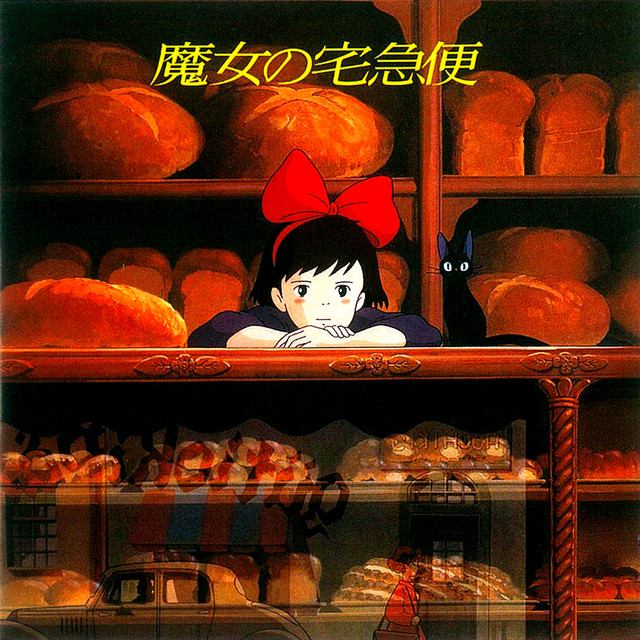
Album: 魔女の宅急便 イメージアルバム
Picture this: a young Japanese composer sits at his synthesizer in the late 1980s, tasked with creating an entire musical world for a story about a teenage witch learning to fly. But there’s a catch – he needs to imagine not the familiar landscapes of Japan, but something distinctly European, somewhere around the Mediterranean. This was Joe Hisaishi’s challenge when crafting the image album for Kiki’s Delivery Service, and nowhere is this cultural bridge more beautifully realized than in “Pan’ya-san no Mado” (The Bakery Window).
The song emerges from what Hisaishi describes as a deliberately vague European inspiration – “somewhere around the Mediterranean” – yet it captures something universally recognizable about small-town life and the warmth of community gathering places. Built around a gentle, lilting melody in a major key, the track unfolds at a leisurely tempo that mirrors the unhurried pace of a neighborhood bakery where locals might stop for their morning bread and a chat.
What makes this piece particularly fascinating is its place in Hisaishi’s creative process. The entire image album was conceived as a musical sketchbook – raw melodies and simple synthesizer arrangements that would later be fully orchestrated for the film. Think of it as the musical equivalent of an animator’s storyboard, capturing the essential emotional beats before the detailed work begins. “The Bakery Window” exemplifies this approach perfectly, with its straightforward synth arrangement allowing the melody’s inherent charm to shine through without ornamental distraction.
The timing of this project created unique pressures for Hisaishi. His schedule was already packed with a solo album recording in New York when the Kiki project landed on his desk. This collision of commitments forced an innovative collaboration with directors Isao Takahata and Hayao Miyazaki. Rather than working in isolation, the three met extensively to map out exactly which scenes would need musical accompaniment. This planning session became the foundation for Hisaishi’s compositional approach – each piece, including “The Bakery Window,” was written with a specific narrative moment in mind.
The remarkable thing about this image album is how precisely it predicted the final film’s needs. Of all the tracks Hisaishi composed, only two wouldn’t make it into the actual movie soundtrack. This near-perfect correspondence between image album and final score reveals the depth of understanding between composer and directors. “The Bakery Window” was clearly envisioned as soundtrack to a specific scene – likely the moments when Kiki first encounters the warmth and bustle of Osono’s bakery, finding her first taste of belonging in an unfamiliar town.
Musically, the piece showcases Hisaishi’s gift for melody that transcends cultural boundaries. While inspired by European folk traditions, the harmonic language remains accessible to Japanese audiences, and the simple arrangement ensures the tune lodges itself in listeners’ memories. The synthesizer’s clean, bright tones evoke both the warmth of fresh bread and the optimism of new beginnings – perfect emotional coloring for Kiki’s journey.
This approach – creating detailed musical sketches before full orchestration – would become a hallmark of Hisaishi’s film scoring method. By working out the essential melodic and emotional content first, he ensures that later orchestral arrangements serve the music rather than overwhelming it. “The Bakery Window” demonstrates how effective this process can be; even in its simple synthesized form, the piece communicates everything it needs to about comfort, community, and the small pleasures that make a place feel like home.
The Mediterranean influence Hisaishi sought appears not in obvious musical quotations but in the piece’s overall warmth and leisurely feel. There’s something in the melodic contour and gentle rhythm that evokes sun-drenched European squares and the unhurried social rhythms of small towns where the local bakery serves as an informal community center.
What’s particularly striking about “The Bakery Window” is how it captures the perspective of an outsider gradually becoming part of a community. The melody begins simply, almost tentatively, then grows more confident as it develops – much like Kiki herself as she settles into life in Koriko. This emotional arc, embedded in the musical structure, shows Hisaishi’s sophisticated understanding of how melody can mirror character development.
In the broader context of Hisaishi’s career, this piece represents his mastery of creating music that feels both specific to its intended setting and universally relatable. The bakery window becomes a metaphor for the threshold between outsider and insider, between longing and belonging – themes that resonate far beyond the specific story of a young witch finding her place in the world.
- かあさんのホウキRead Review
- ナンパ通りRead Review
- 町の夜Read Review
- 元気になれそうRead Review
- 渚のデイトRead Review
- 風の丘Read Review
- トンボさんRead Review
- リリーとジジRead Review
- 世界って広いわRead Review
- パン屋さんの窓Now Playing
- 突風Read Review
- 木洩れ陽の路地Read Review