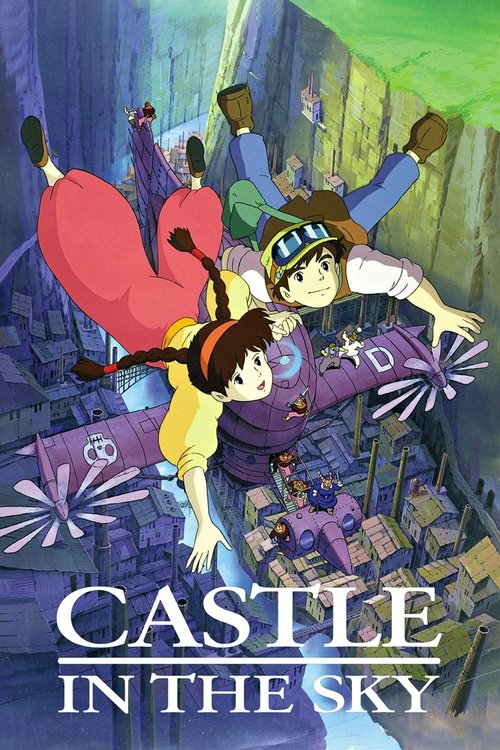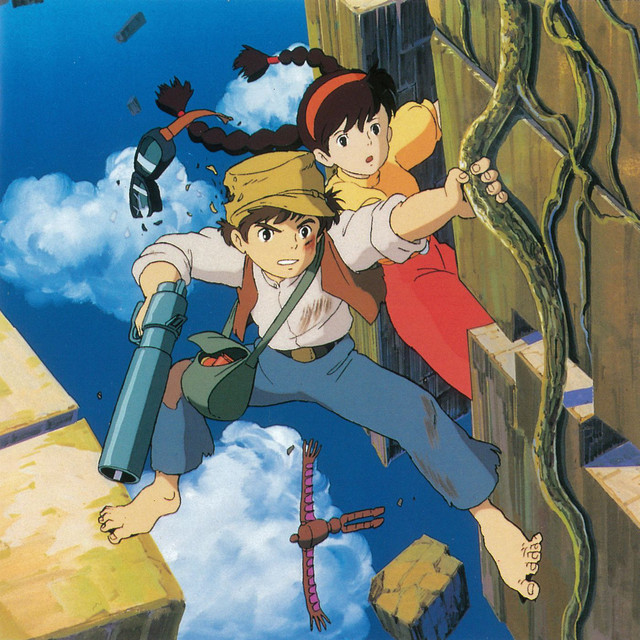
Album: 天空の城ラピュタ サウンドトラック ~飛行石の謎~
In the sprawling mythology of Studio Ghibli’s Castle in the Sky, few moments pierce the heart quite like Pazu’s moment of despair. The track “Shitsui no Pazu” – literally “Pazu’s Disappointment” – captures one of cinema’s most devastating emotional turning points through Joe Hisaishi’s deeply personal compositional approach.
This haunting piece emerges from what may be the most meticulously crafted film score in Japanese animation history. Unlike today’s digital workflows, Hisaishi faced a monumental challenge in 1986: synchronizing every musical phrase to Hayao Miyazaki’s hand-drawn animation with surgical precision. His solution was revolutionary for its time.
Armed with rush film footage and a Fairlight III sampler – cutting-edge technology that cost three times the typical film budget – Hisaishi began his process by timing every crucial visual moment down to the second. Each frame’s emotional weight was catalogued, each character movement mapped to musical phrases. This wasn’t just scoring; it was emotional archaeology.
The collaborative process began in earnest on June 23rd, 1986, in a modest coffee shop near Studio Ghibli. Miyazaki, producer Isao Takahata, and Hisaishi huddled around a table, dissecting the image album tracks that would become the foundation for the final score. Miyazaki’s concept notes spoke of “vast expanses, the tree of life, distant time, sunlight” – abstract poetry that Hisaishi would need to translate into concrete musical language.
For “Shitsui no Pazu,” Hisaishi deliberately stripped away the bombast that might accompany such a pivotal scene. The track unfolds in a minor key, built around a simple piano melody that seems to stumble and fall upon itself. Where other composers might have reached for dramatic orchestral swells, Hisaishi chose restraint – a single oboe carrying Pazu’s grief over sparse string accompaniment.
This minimalist approach reflected Hisaishi’s core philosophy for the entire Castle in the Sky project. After the dense, sample-heavy score for the film Arion, he made a conscious decision to return to acoustic simplicity. “I wanted children to listen and feel their hearts warm,” he explained. Every note had to serve love, dreams, and adventure – even in moments of profound loss.
The technical execution was equally demanding. Starting June 24th at Wonder Station studio, Hisaishi constructed the rhythmic foundation using the Fairlight’s primitive sampling capabilities. Two weeks later, nearly fifty orchestra musicians crowded into Nikkatsu Studio – the largest ensemble ever assembled for a Japanese animated film at that time. The studio could barely contain them.
This massive orchestral investment wasn’t mere indulgence. Castle in the Sky would be Miyazaki’s first film mixed in 4-channel Dolby Stereo, and Hisaishi understood the implications. “This work absolutely must be in 4-channel Dolby,” he insisted, recognizing that spatial audio would allow subtle details like the lonely echo in “Shitsui no Pazu” to envelope audiences completely.
The track’s emotional impact stems from Hisaishi’s understanding that disappointment isn’t loud – it’s hollow. The melody moves in hesitant steps, never quite finding resolution. Woodwinds enter and retreat like uncertain thoughts. The overall tempo feels suspended, as if time itself has stopped for Pazu’s realization that his dreams might be slipping away.
By July 12th, when the final trackdown was completed, Hisaishi had created something unprecedented in animation scoring. “Shitsui no Pazu” exemplifies his belief that film music should match visual movement precisely – not just in timing, but in emotional rhythm. Every pause in the melody corresponds to Pazu’s hesitation, every harmonic shift mirrors his internal struggle.
This approach would influence decades of film scoring, but in 1986, it felt revolutionary. Hisaishi was proving that animated films deserved the same musical sophistication as live-action cinema. His willingness to let silence and space carry as much weight as orchestral flourishes created a new language for expressing animated emotion.
Listening to “Shitsui no Pazu” today, its power remains undiminished. The track serves as a perfect microcosm of Hisaishi’s mature style – technically precise yet emotionally direct, complex in construction yet simple in impact. In just a few minutes of music, he captures something universal about the moment when childhood optimism first encounters adult disappointment.
That coffee shop meeting in June 1986 launched not just a soundtrack, but a new standard for how music could serve animation. Through tracks like “Shitsui no Pazu,” Hisaishi demonstrated that the most powerful moments in film often require the gentlest musical touch.
- 空から降ってきた少女Read Review
- スラッグ溪谷の朝Read Review
- 愉快なケンカ(~追跡)Read Review
- ゴンドアの思い出Read Review
- 失意のパズーNow Playing
- ロボット兵(復活~救出)Read Review
- 合唱 君をのせてRead Review
- シータの決意Read Review
- タイガーモス号にてRead Review
- 破滅への予兆Read Review
- 月光の雲海Read Review
- 天空の城ラピュタRead Review
- ラピュタの崩壊Read Review
- 君をのせてRead Review