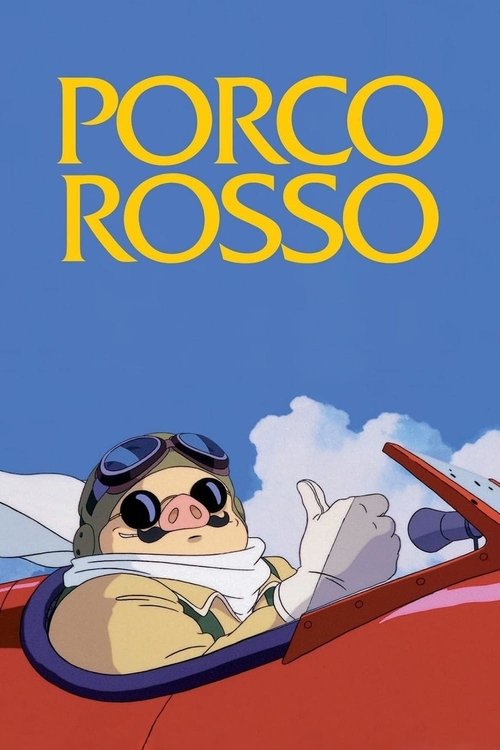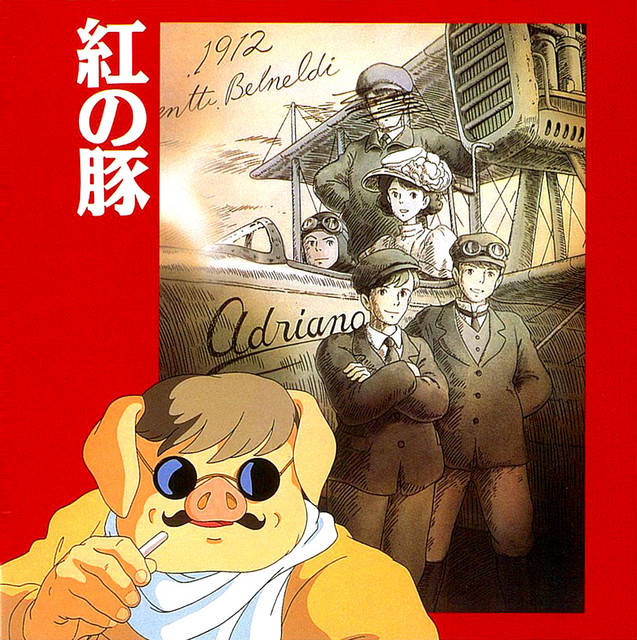
Album: 紅の豚 イメージアルバム
What happens when a master filmmaker hands six poems to a composer and asks for ’embarrassing music’? The answer lies in one of Joe Hisaishi’s most introspective works: ‘Marco and Gina’s Theme’ from the Porco Rosso Image Album, a piece that would eventually evolve into the beloved ‘Bygone Days’ in the final film.
This transformation tells a fascinating story about artistic collaboration, creative vulnerability, and the delicate balance between personal expression and cinematic storytelling. When Hayao Miyazaki approached Hisaishi for what would become Porco Rosso, he didn’t hand over a traditional brief. Instead, he presented six evocative poems: ‘Flying Boat Pilot’s Tango,’ ‘Ascension,’ ‘Adriatic Sea at Twilight,’ ‘Night Flight,’ ‘Secret Garden,’ and ‘Merry-Go-Round.’ These weren’t mere inspirational fragments but primary materials designed to share the film’s emotional landscape.
Among these poetic sketches, the themes that would become ‘Marco and Gina’s Theme’ emerged from Miyazaki’s deeply personal vision. The director’s request was both simple and profound: ‘Please make embarrassing music that stirs emotions.’ Producer Toshio Suzuki recalled how this unusual directive captured Miyazaki’s desire for music that would be unabashedly romantic, even vulnerable.
Hisaishi’s initial response in the image album reveals his instinctive understanding of this request. ‘Marco and Gina’s Theme’ unfolds in a tender waltz tempo, built around strings and woodwinds that seem to breathe with nostalgic longing. The melody carries an almost conversational quality, as if the music itself were sharing intimate memories between old friends. This wasn’t music designed to overwhelm or impress – it was crafted to touch something deeper.
The creative process, however, wasn’t without its challenges. Hisaishi later reflected with characteristic honesty about his approach: ‘This was a film with strong personal feelings from Miyazaki, and I should have pulled back more, but there were parts where I was tempted to make it more action-oriented. I still regret that.’ This admission reveals the composer’s ongoing struggle to balance his instincts with the director’s vision.
What makes ‘Marco and Gina’s Theme’ particularly significant is how it functions as a bridge between conception and realization. In the image album, it exists in a purer form – less constrained by narrative demands, more free to explore emotional territory. The theme’s gentle accordion touches and subtle jazz harmonies hint at the Mediterranean setting while maintaining an intimate, chamber-music quality.
When the theme evolved into ‘Bygone Days’ for the final film, it retained this emotional core while adapting to specific dramatic moments. This evolution demonstrates one of Hisaishi’s greatest strengths: his ability to create music that serves both as standalone art and as integral storytelling.
The recording process itself reflected Miyazaki’s and Hisaishi’s commitment to authenticity. Rather than relying on synthesizers or studio tricks, they chose a full 70-piece orchestra recorded at Aoi Studio during May and June 1992. This decision to prioritize acoustic sound meant every nuance, every breath of the strings, every whispered phrase from the woodwinds would carry organic warmth.
Listening to ‘Marco and Gina’s Theme’ today, one can hear the seeds of what would become one of Studio Ghibli’s most emotionally resonant scores. The piece doesn’t announce itself with grand gestures or sweeping themes. Instead, it works through accumulated detail – a hesitant phrase here, a gentle harmonic shift there, building an emotional landscape that feels both specific and universal.
This approach reflects Hisaishi’s broader philosophy during this period of his career. Rather than imposing musical ideas onto visual narratives, he sought to discover the music already inherent in Miyazaki’s vision. The six poems weren’t just inspiration – they were roadmaps to emotional territories that words alone couldn’t navigate.
The success of this collaborative method extends beyond ‘Marco and Gina’s Theme’ to two other pieces from the image album: the prototype of ‘Flying Boatmen’ called ‘Dabo-Haze,’ and the original version of ‘Piccolo’s Women’ titled ‘Piccolo Company.’ Each piece demonstrates how image album compositions can serve as emotional sketches, allowing both composer and director to explore possibilities before committing to final versions.
In retrospect, ‘Marco and Gina’s Theme’ stands as evidence of what happens when artistic vulnerability becomes creative strength. Miyazaki’s request for ’embarrassing music’ wasn’t about sentimentality – it was about emotional honesty. Hisaishi’s response created a piece that dares to be gentle in a medium often dominated by bombast, intimate in a format designed for public consumption.
This willingness to embrace musical vulnerability would become a hallmark of Hisaishi’s work with Studio Ghibli, establishing a template for how film music could serve story and emotion simultaneously. In ‘Marco and Gina’s Theme,’ we hear not just the beginning of a beautiful film score, but the sound of two artists learning to trust each other’s creative instincts.
- アドリア海の青い空Read Review
- 冒険飛行家の時代Read Review
- 真紅の翼Read Review
- 雲海のサボイアRead Review
- ピッコロ社Read Review
- 戦争ゴッコRead Review
- ダボハゼRead Review
- アドリアーノの窓Read Review
- 世界恐慌Read Review
- マルコとジーナのテーマNow Playing