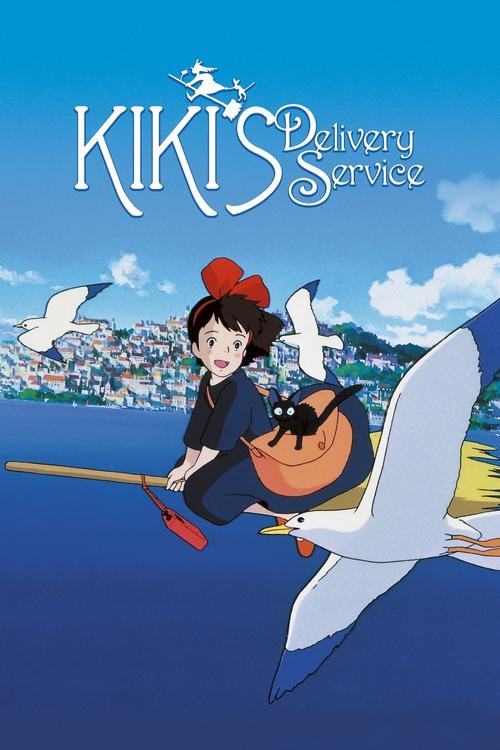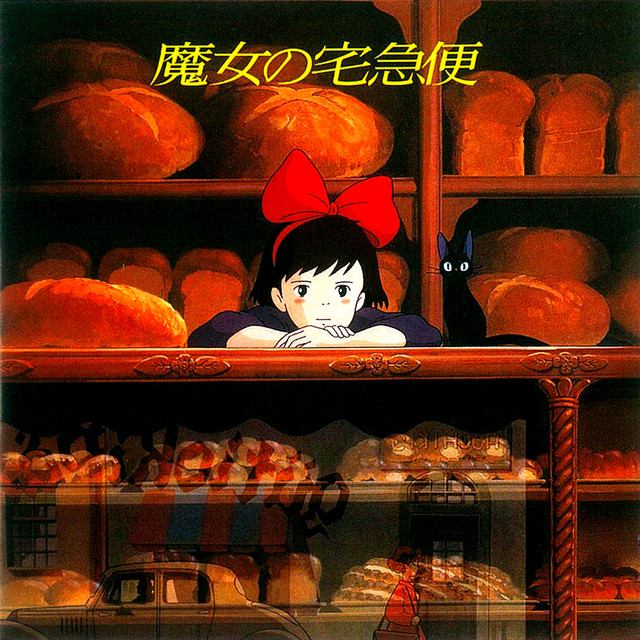
Album: 魔女の宅急便 イメージアルバム
When Joe Hisaishi sat down to compose the image album for Kiki’s Delivery Service in the late 1980s, he faced an unusual creative challenge. Tasked with capturing the essence of “somewhere European, perhaps around the Mediterranean” without ever having scored a film set in such a location, he would craft one of his most evocative pieces in ‘Machi no Yoru’ (Town at Night).
This track serves as a perfect window into Hisaishi’s remarkable creative process during what would become one of Studio Ghibli’s most beloved soundtracks. Unlike his later, fully orchestrated film scores, ‘Machi no Yoru’ exists in its raw, crystalline form—a musical sketch that captures the atmospheric heart of Kiki’s nighttime adventures through the cobblestone streets of Koriko.
The piece unfolds in a gentle minor key, immediately establishing an intimate nocturnal mood. Built primarily around synthesizer textures, it features delicate layers that suggest the quiet bustle of a European town settling into evening. Hisaishi’s choice to center the arrangement on synthesizers wasn’t born from limitation but from artistic vision—these image album tracks were conceived as musical rough sketches, comparable to the visual storyboards that guide film production.
What makes ‘Machi no Yoru’ particularly fascinating is how it embodies the collaborative relationship between Hisaishi, director Hayao Miyazaki, and producer Isao Takahata. The nearly one-to-one correspondence between the image album tracks and specific scenes in the final film reveals just how meticulously the trio had plotted the musical landscape before cameras ever rolled. Only two tracks from the original album went unused, a remarkably high success rate that speaks to their shared vision.
Listening to ‘Machi no Yoru,’ one can hear Hisaishi wrestling with a fundamental artistic decision that would define the entire Kiki’s Delivery Service score. Both Miyazaki and Takahata had specifically requested that he avoid minor-key, melancholic music despite the story’s themes of displacement and growing up. “The main character is a girl becoming independent and growing,” Hisaishi later explained, “so we wanted to eliminate as much emotionally minor music as possible and use only bright music.”
Yet in ‘Machi no Yoru,’ we catch glimpses of the more contemplative Hisaishi—the composer who would later create the haunting themes for Princess Mononoke and Spirited Away. The track walks a careful line, maintaining an overall sense of wonder and possibility while acknowledging the natural introspection that comes with nightfall in an unfamiliar place.
The Mediterranean influence Hisaishi sought to capture emerges through subtle instrumental choices layered over the synthesizer foundation. Gentle guitar arpeggios echo the classical traditions of Spanish and Italian folk music, while percussion elements suggest the rhythmic complexity of European folk traditions. These aren’t literal recreations but rather impressionistic brushstrokes that paint an emotional landscape rather than a geographical one.
Perhaps most importantly, ‘Machi no Yoru’ demonstrates Hisaishi’s understanding of how music functions in animation. Rather than overwhelming the listener with complex arrangements, the track creates space—room for dialogue, sound effects, and the visual poetry of Miyazaki’s animation. It’s music designed to enhance rather than dominate, to suggest rather than declare.
This restraint proved prescient when the track was later adapted for the film proper. The basic melodic and harmonic structure of ‘Machi no Yoru’ would eventually be woven into several key scenes, its themes echoing through Kiki’s nighttime flights and quiet moments of reflection in her new home.
The image album approach also allowed Hisaishi to experiment with the “breath instruments” that would become central to the film’s final score. While ‘Machi no Yoru’ itself remains primarily electronic, it established the atmospheric foundation upon which later accordion, woodwind, and ocarina parts would build. These wind instruments, as music scholar Hidekuni Maejima noted, served as symbols of Kiki’s life force, her connection to flight, and the very air of Koriko itself.
Today, ‘Machi no Yoru’ stands as more than just a preparatory sketch for a beloved film score. It represents a moment of pure creative possibility, when Hisaishi was free to imagine European nights and Mediterranean breezes through purely musical means. In its synthesized simplicity, it captures something essential about the magic of animation music—the ability to make the impossible feel inevitable, and the distant feel intimately familiar.
For European listeners, the track offers a curious mirror: how does our own musical heritage sound when filtered through Japanese sensibility and electronic instrumentation? The answer, as ‘Machi no Yoru’ suggests, is both foreign and deeply recognizable—much like the experience of watching Kiki soar over a European town that exists only in animation, yet feels more real than many places we’ve actually visited.
- かあさんのホウキRead Review
- ナンパ通りRead Review
- 町の夜Now Playing
- 元気になれそうRead Review
- 渚のデイトRead Review
- 風の丘Read Review
- トンボさんRead Review
- リリーとジジRead Review
- 世界って広いわRead Review
- パン屋さんの窓Read Review
- 突風Read Review
- 木洩れ陽の路地Read Review