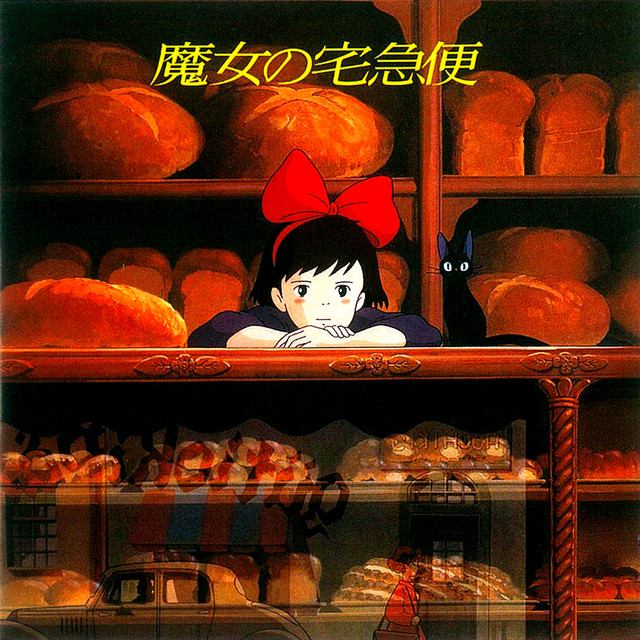
Album: 魔女の宅急便 イメージアルバム
In the world of film music, few composers possess the ability to capture an entire world’s essence through simple melodic sketches. Joe Hisaishi’s “Lily and Jiji” from the Kiki’s Delivery Service Image Album stands as a fascinating window into this rare creative process—a piece that began as a rough musical sketch and eventually found its place in one of animation’s most beloved soundtracks.
The Image Album for Kiki’s Delivery Service represents something unique in film music: a collection of musical blueprints that would later translate almost one-to-one into the final soundtrack. Only two tracks from this preliminary album failed to make it into the finished film, revealing the extraordinary level of collaboration between Hisaishi and director Hayao Miyazaki from the very beginning of the creative process.
“Lily and Jiji” embodies the album’s Mediterranean-inspired aesthetic, built around Hisaishi’s vision of “somewhere vaguely European, perhaps around the Mediterranean.” The track features a deceptively simple arrangement centered on synthesizers, with subtle additions of violin, guitar, and percussion that evoke the European atmosphere Hisaishi sought to create. This restraint in orchestration serves a purpose—these image album tracks function as musical storyboards, allowing the melody to breathe and establish its emotional core without the elaborate orchestrations that would come later.
What makes “Lily and Jiji” particularly intriguing is how it demonstrates Hisaishi’s unconventional approach to film scoring. Rather than matching music directly to emotion—sad music for sad scenes, dramatic music for action—Hisaishi pursued what he called a philosophy of comfort over manipulation. “I aimed to make music that would make viewers feel comfortable rather than appealing directly to their emotions,” he explained of his approach to the project.
This philosophy becomes audible in “Lily and Jiji” through its gentle, almost pastoral quality. Written in a major key with a moderate tempo that suggests both forward movement and peaceful contemplation, the piece avoids the dramatic peaks and valleys that might overwhelm the listener. Instead, it creates an atmosphere of warmth and security—qualities essential to Kiki’s character and her relationship with her companion Jiji.
The track also hints at the broader musical language Hisaishi would develop for the full soundtrack, particularly his emphasis on wind instruments as symbols of life force and flight. While “Lily and Jiji” in its image album form relies primarily on synthesized sounds, it establishes melodic patterns that would later be adapted for the breath-powered instruments—ocarina, accordion, and woodwinds—that define the film’s musical identity. This connection between breath, wind, and life becomes crucial to understanding Kiki’s story, where the ability to fly represents not just magical power but spiritual vitality.
The creative process behind “Lily and Jiji” reveals Hisaishi’s remarkable ability to compose cinematically without having seen the final images. Working from Miyazaki’s concepts and early discussions, he created music that would prove remarkably adaptable to specific scenes while maintaining its own coherent emotional logic. This approach required tremendous trust between composer and director, as well as Hisaishi’s deep understanding of Miyazaki’s storytelling sensibilities.
Listening to “Lily and Jiji” today, one can hear the seeds of themes that would later blossom in the film’s most memorable moments. The melody carries both the innocence of youth and the bittersweet awareness of growing up—central tensions in Kiki’s journey. The European folk influences in the harmonization reflect the film’s setting while remaining distinctly Hisaishi in their emotional directness and melodic clarity.
The track’s simplicity proves deceptive upon closer examination. Hisaishi’s synthesizer work creates layers of texture that suggest a full ensemble while maintaining the intimate, sketch-like quality that defines the image album. The interplay between melody and harmony demonstrates his classical training while the overall aesthetic reflects his deep understanding of popular music traditions.
“Lily and Jiji” ultimately serves as more than just a preliminary version of a film cue—it represents a complete artistic statement in its own right. The image album format allowed Hisaishi to explore musical ideas without the constraints of precise timing or dramatic necessity, resulting in pieces that capture emotional essences rather than specific narrative moments.
This creative freedom produced music of remarkable durability. Decades after its creation, “Lily and Jiji” continues to evoke the same sense of European warmth and gentle adventure that Hisaishi originally envisioned. It stands as evidence that the most powerful film music often emerges not from literal interpretation of images, but from the composer’s ability to translate abstract concepts into musical language that speaks directly to the listener’s imagination.
- かあさんのホウキRead Review
- ナンパ通りRead Review
- 町の夜Read Review
- 元気になれそうRead Review
- 渚のデイトRead Review
- 風の丘Read Review
- トンボさんRead Review
- リリーとジジNow Playing
- 世界って広いわRead Review
- パン屋さんの窓Read Review
- 突風Read Review
- 木洩れ陽の路地Read Review