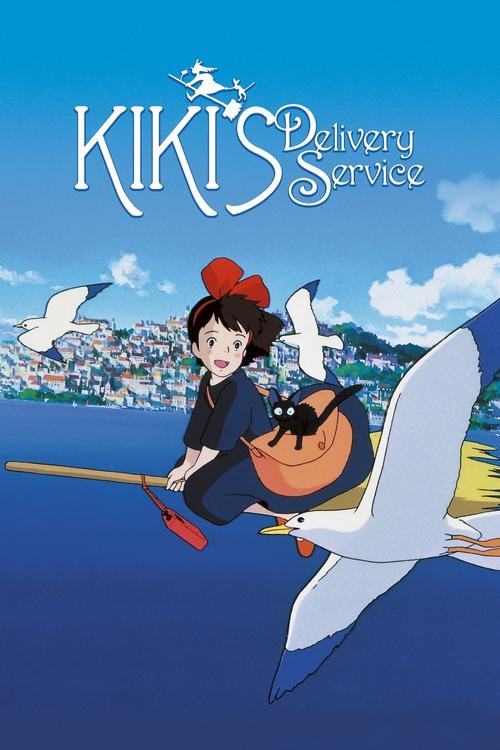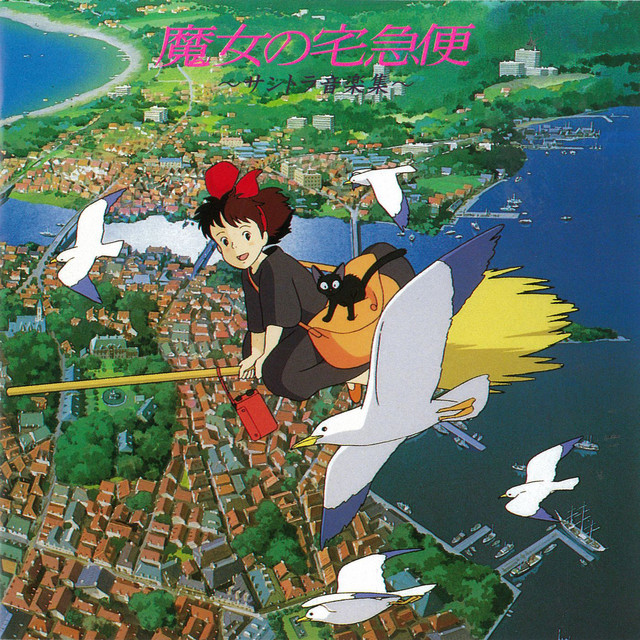
Album: 魔女の宅急便 サントラ音楽集
Deep within the soundtrack archives of Studio Ghibli’s beloved Kiki’s Delivery Service lies a haunting piece that audiences never heard. “Tobenai!” (Can’t Fly!) represents one of Joe Hisaishi’s most emotionally charged compositions—a crisis theme written specifically for the moment when young witch Kiki loses her magical ability to soar through the skies.
This unused track offers a fascinating glimpse into Hisaishi’s creative process during one of the most challenging periods of his career. In 1989, the composer found himself caught between two demanding projects: his ongoing work in New York and the urgent deadline for Miyazaki’s latest film. The scheduling nightmare forced a month-long suspension of work on the Kiki score, creating unprecedented pressure that would push Hisaishi’s compositional skills to their absolute limits.
When Hisaishi returned to Japan in June, he faced an almost impossible task. With the film’s July 29th national release date looming, he had mere weeks to complete additional compositions and arrangements. The following day after his return, he was already in meetings. Two days later, he was in the recording studio. This breakneck pace would culminate in a full orchestral recording session in early July—a timeline that seems almost reckless by today’s standards.
“Tobenai!” emerged from this crucible of creativity under pressure. The piece serves as what musicologist Hidekuni Maeshima calls a “crisis theme,” designed to underscore Kiki’s most vulnerable moment when her powers begin to wane. Though ultimately cut from the final film, the composition reveals Hisaishi’s deep understanding of the character’s emotional journey and his ability to translate psychological states into musical language.
The track showcases the European-influenced aesthetic that defines the entire Kiki soundtrack. Rather than relying on his usual arsenal of synthesizers, Hisaishi deliberately moved toward organic instrumentation. “This time I significantly reduced the use of synthesizer-based pieces,” he explained. “Since the content of this work is realistic, I brought everything closer to live sound overall.” This philosophy permeates “Tobenai!,” where traditional orchestral instruments carry the emotional weight without electronic enhancement.
The composition features prominent use of wind instruments—a choice that carries profound symbolic meaning throughout the score. Hisaishi incorporated ocarina, accordion, and various woodwinds as representations of breath and wind, the very forces that enable Kiki’s flight. In “Tobenai!,” these instruments take on a different character entirely. Instead of lifting the protagonist skyward, they seem to gasp and struggle, musically depicting a young witch grappling with the terrifying loss of her identity.
Hisaishi’s European inspiration extended beyond mere atmosphere. He drew heavily from Mediterranean folk traditions, incorporating the dulcimer—an ancient stringed instrument that served as a precursor to the piano—alongside guitar and accordion. These choices weren’t arbitrary; they created what he described as “Greek-style nuances” that transported listeners to the sun-drenched coastal town where Kiki makes her new home.
The unused nature of “Tobenai!” speaks to the collaborative relationship between Hisaishi and director Hayao Miyazaki. Despite the composer’s clear emotional investment in the piece, Miyazaki ultimately chose a different approach for depicting Kiki’s crisis. This decision highlights the delicate balance between musical storytelling and visual narrative—sometimes the most powerful compositions must be sacrificed for the greater good of the film.
The track’s three-quarter time signature aligns with Hisaishi’s broader approach to the score, which featured numerous dance-like pieces in 3/4 time. However, “Tobenai!” subverts the typically joyous associations of waltz rhythm, creating an unsettling undercurrent that mirrors Kiki’s internal turmoil. The melody line carries hints of the Mediterranean influences present throughout the album, but twisted into something more ominous and uncertain.
Listening to “Tobenai!” today, one can hear the exhaustion and pressure Hisaishi faced during its creation. Yet rather than diminishing the work, these circumstances seem to have intensified its emotional authenticity. The piece captures not just Kiki’s fictional crisis, but perhaps something of the composer’s own professional challenges during that frantic summer of 1989.
The existence of unused tracks like “Tobenai!” reminds us that film scoring involves countless creative decisions, many of which remain hidden from audiences. For every memorable melody that makes it to the screen, others languish in archives, representing roads not taken and emotions unexpressed. In Hisaishi’s case, these discarded pieces often prove just as revealing as his celebrated works, offering insights into an artist’s process under extreme pressure.
This crisis theme ultimately stands as a testament to Hisaishi’s commitment to character-driven composition, even when working against impossible deadlines. Though audiences never experienced “Tobenai!” during Kiki’s moment of doubt, the piece remains a powerful example of music’s ability to capture the precise emotional texture of losing one’s wings.
- 晴れた日に…Read Review
- 旅立ち
- 海の見える街Read Review
- 空とぶ宅急便Read Review
- パン屋の手伝いRead Review
- 仕事はじめRead Review
- 身代わりジジRead Review
- ジェフRead Review
- 大忙しのキキRead Review
- パーティーに間に合わないRead Review
- オソノさんのたのみ事…Read Review
- プロペラ自転車Read Review
- とべない!Now Playing
- 傷心のキキRead Review
- ウルスラの小屋へRead Review
- 神秘なる絵Read Review
- 暴飛行の自由の冒険号Read Review
- おじいさんのデッキブラシRead Review
- デッキブラシでランデブーRead Review