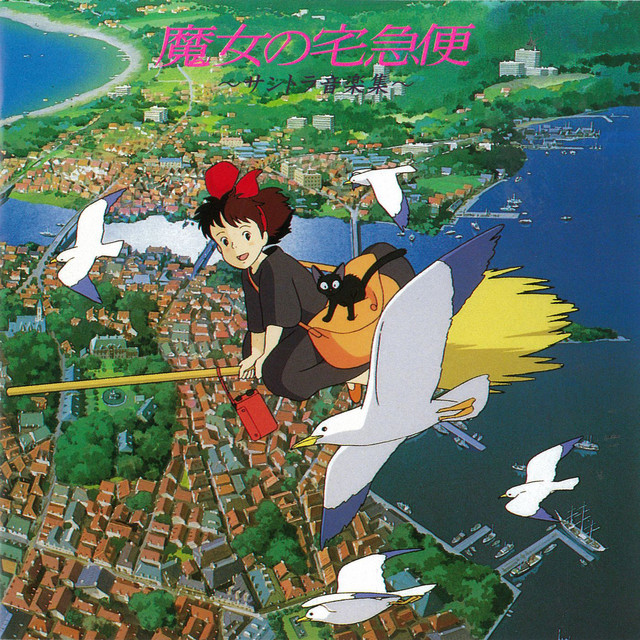
Album: 魔女の宅急便 サントラ音楽集
In the summer of 1989, Joe Hisaishi found himself in an impossible situation. Fresh off a plane from New York where he had been recording other projects, the composer had exactly two days to prepare for what would become one of his most beloved soundtracks. The film was Kiki’s Delivery Service, and among the tracks he would craft under this crushing deadline was “Osono-san no Tanomigoto” – a piece that would perfectly encapsulate his vision of European folk traditions filtered through Japanese sensibilities.
The story behind this particular composition reveals much about Hisaishi’s creative philosophy and his ability to work under extreme pressure. When he returned to Japan, the composer faced what his collaborator Hidekuni Maeshima later described as an “unthinkable tightrope schedule.” Production had been halted for a month due to conflicts with his New York recording sessions, and now everything had to be completed in time for the film’s July 29th nationwide release.
Yet rather than compromise his artistic vision, Hisaishi used these constraints to push his music in a bold new direction. “Osono-san no Tanomigoto” emerged from his decision to dramatically reduce synthesizer usage in favor of acoustic instruments – a choice that would define the entire soundtrack’s character. The piece features the dulcimer, a folk instrument that served as a precursor to the modern piano, alongside guitar and accordion, creating what Hisaishi described as distinctly “European fragrance.”
The composer’s approach to this track exemplifies his broader philosophy for the Kiki soundtrack. He deliberately sought to evoke Mediterranean and Greek musical nuances, moving away from the heavily synthesized scores that had become commonplace in animation. “This time I drastically reduced the use of synthesizer-based compositions,” Hisaishi explained. “Since the content of this work is realistic, I brought the overall sound closer to live instruments.”
“Osono-san no Tanomigoto” showcases another key element of Hisaishi’s vision: the prevalence of three-quarter time signatures that give the music its dance-like quality. This waltz-time foundation connects the piece to European folk dance traditions while serving the film’s narrative needs. The track accompanies scenes of Osono, the baker’s wife who becomes Kiki’s first friend in the seaside town of Koriko, and the lilting rhythm mirrors both her warm personality and the gentle daily rhythms of the town itself.
Perhaps most significantly, the instrumentation choices in “Osono-san no Tanomigoto” reflect Hisaishi’s sophisticated understanding of symbolic musical language. The piece prominently features wind instruments – accordion, wooden flutes, and other breath-powered instruments that became a signature of the entire score. This wasn’t mere aesthetic choice; as musicologist Maeshima noted, these “breath equals wind” instruments represent multiple layers of meaning: the wind that carries Kiki through the sky, the atmospheric essence of Koriko town, and most importantly, Kiki’s own life force and vitality.
The accordion’s prominent role in “Osono-san no Tanomigoto” deserves particular attention. Set in what appears to be a 3/4 waltz tempo in a major key, the accordion’s wheezing, breathing quality perfectly captures both the European folk aesthetic Hisaishi sought and the deeper symbolic meaning of breath as life force. When Osono makes her request to Kiki – asking the young witch to deliver a forgotten item to a customer – the music swells with the same generous spirit that defines the character.
This approach stands in fascinating contrast to the film’s use of popular music. Director Isao Takahata chose Yumi Matsutoya’s urban pop songs to represent radio broadcasts, specifically selecting music that would resonate with contemporary Japanese audiences while maintaining the story’s modern elements. Against this backdrop, Hisaishi’s folk-influenced instrumental pieces like “Osono-san no Tanomigoto” ground the magical elements in something more timeless and universal.
The lightning-fast composition and recording process adds another layer to the track’s significance. Hisaishi completed the additional compositions and arrangements in mere days, then recorded with a full orchestra in early July. The spontaneous energy this created can be heard in “Osono-san no Tanomigoto” – there’s an immediacy and freshness that might have been lost with more extensive refinement.
What makes “Osono-san no Tanomigoto” particularly remarkable is how it balances cultural specificity with universal appeal. While rooted in European folk traditions, the piece speaks to anyone who has experienced the kindness of strangers or the warmth of community acceptance. Osono’s character represents the bridge between Kiki’s magical world and ordinary human kindness, and Hisaishi’s music captures this perfectly through its blend of exotic instruments and familiar emotional resonance.
In the context of Hisaishi’s broader career, this track represents a pivotal moment in his evolution as a composer. The decision to embrace acoustic folk instruments and reduce electronic elements would influence his approach to future Ghibli films and establish a template for how Western classical and folk traditions could be authentically integrated into Japanese storytelling. “Osono-san no Tanomigoto” stands as proof that sometimes the greatest artistic breakthroughs emerge not from luxury and time, but from the creative pressure that forces composers to trust their deepest musical instincts.
- 晴れた日に…Read Review
- 旅立ち
- 海の見える街Read Review
- 空とぶ宅急便Read Review
- パン屋の手伝いRead Review
- 仕事はじめRead Review
- 身代わりジジRead Review
- ジェフRead Review
- 大忙しのキキRead Review
- パーティーに間に合わないRead Review
- オソノさんのたのみ事…Now Playing
- プロペラ自転車Read Review
- とべない!Read Review
- 傷心のキキRead Review
- ウルスラの小屋へRead Review
- 神秘なる絵Read Review
- 暴飛行の自由の冒険号Read Review
- おじいさんのデッキブラシRead Review
- デッキブラシでランデブーRead Review