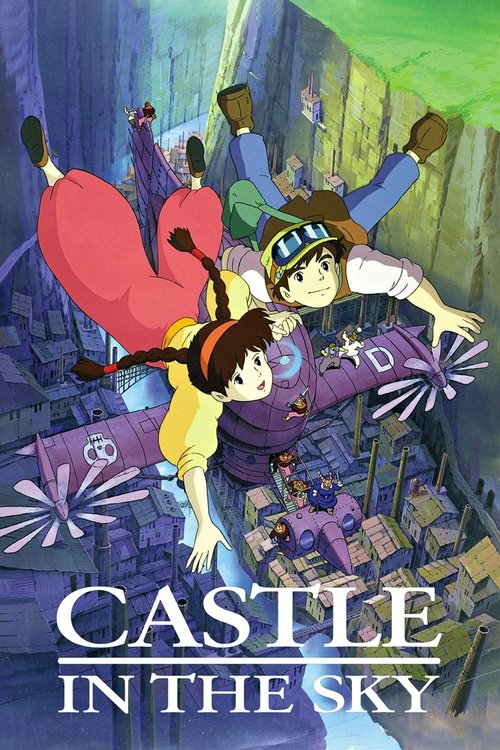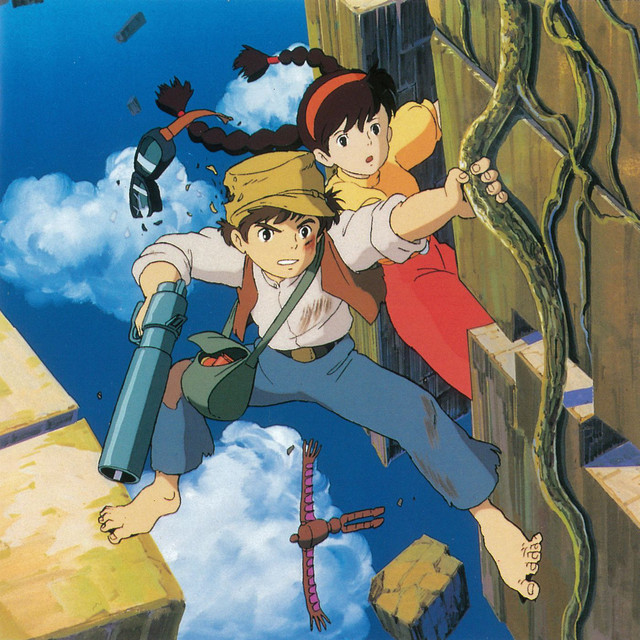
Album: 天空の城ラピュタ サウンドトラック ~飛行石の謎~
When Joe Hisaishi sat down to compose music for Castle in the Sky in 1986, he made a revolutionary decision that would transform how animated films approached the marriage of sound and image. His track ‘On the Tiger Moth’ (Taigāmosu-gō ni te) serves as a perfect example of this new methodology – one that demanded absolute precision between visual movement and musical flow.
The story begins in a small coffee shop near Studio Ghibli on June 23rd, where three titans of Japanese animation gathered around a table. Hayao Miyazaki, Isao Takahata, and Hisaishi engaged in intense discussions about the film’s musical direction, using the previously recorded image album as their starting point. What emerged from this meeting wasn’t just another soundtrack approach, but a complete reimagining of how music could serve animation.
Hisaishi’s vision was uncompromising: ‘This time, I want to thoroughly focus on matching the movement of the pictures with the flow of the music.’ This wasn’t merely about creating atmospheric background music – it was about surgical precision. Using rush film videos, he meticulously checked the timing of every visual movement down to the second, inputting this data into a Fairlight III synthesizer to construct the rhythmic foundation.
The Tiger Moth sequence perfectly demonstrates this philosophy in action. As the rickety aircraft navigates through dangerous skies, Hisaishi’s composition mirrors every mechanical vibration, every wind gust, every moment of tension in the cockpit. The music doesn’t just accompany the action – it becomes the aircraft’s heartbeat, pulsing in perfect synchronization with the propeller’s rotation and the craft’s lurching movements through turbulent air.
This technical precision, however, never overshadowed Hisaishi’s core musical philosophy. He remained committed to creating melodies that children could embrace, music that would warm hearts rather than merely impress with technical wizardry. Coming off his work on ‘Arion,’ which featured extensive sound sampling, Hisaishi deliberately chose a simpler path for Castle in the Sky. Acoustic instruments would dominate, allowing pure melody to shine through the complexity of synchronized timing.
The production schedule reveals the intensity of this approach. Within days of the June 23rd meeting, Hisaishi began recording at Wonder Station, building those crucial rhythm tracks on the Fairlight III. By July 8th, he was conducting nearly fifty orchestra members at Nikkatsu Studio, bringing those precisely timed compositions to life with rich, organic instrumentation. The entire process wrapped just four days later with the final trackdown.
Miyazaki’s creative input shaped the emotional landscape Hisaishi would navigate. His notes about the ‘Castle of Time’ spoke of ‘shining cloud peaks beyond, yearning, lost paradise, darkness containing both wicked and beautiful things, mystery.’ These weren’t technical specifications but emotional coordinates, guiding Hisaishi toward music that could contain such contradictions.
‘On the Tiger Moth’ embodies these contradictions beautifully. The piece opens with a gentle, almost nostalgic melody in A minor, performed primarily on strings and woodwinds. Yet as the sequence progresses, subtle percussion and brass punctuations mirror the aircraft’s mechanical struggles, creating tension without abandoning the underlying warmth. The tempo shifts naturally with the visual rhythm, never feeling forced despite its mathematical precision.
Interestingly, this new approach sometimes required abandoning previous work. The original image album’s Flaptter theme, designed around the cheerful image of something ‘fluttering brightly,’ couldn’t survive the transfer to film. In the actual movie, almost every Flaptter appearance occurs during crisis moments, rendering the original composition inappropriate. Hisaishi adapted without sentiment, understanding that serving the story trumped preserving individual pieces.
This willingness to sacrifice demonstrates the maturity of Hisaishi’s collaborative approach. Unlike composers who jealously guard their creations, he embraced the fluid nature of film scoring. The music existed to serve something larger than itself – the complete animated experience that audiences would encounter.
The success of this methodology extended far beyond Castle in the Sky. It established a new standard for animation scoring, one where music and movement achieve genuine unity rather than mere coexistence. Modern animated films still employ variations of Hisaishi’s frame-by-frame approach, though few achieve the seamless integration he pioneered.
‘On the Tiger Moth’ may seem like a simple cue in a larger soundtrack, but it represents a pivotal moment in animation history. It’s the sound of a composer discovering that true precision doesn’t diminish artistic expression – it amplifies it. When every musical gesture serves both emotional and visual purpose, the result transcends the sum of its parts, creating something that speaks directly to hearts while satisfying the most demanding technical requirements.
In those few minutes of music, Hisaishi proved that innovation doesn’t require abandoning melody, warmth, or accessibility. Sometimes revolution comes through the patient work of making everything fit together perfectly.
- 空から降ってきた少女Read Review
- スラッグ溪谷の朝Read Review
- 愉快なケンカ(~追跡)Read Review
- ゴンドアの思い出Read Review
- 失意のパズーRead Review
- ロボット兵(復活~救出)Read Review
- 合唱 君をのせてRead Review
- シータの決意Read Review
- タイガーモス号にてNow Playing
- 破滅への予兆Read Review
- 月光の雲海Read Review
- 天空の城ラピュタRead Review
- ラピュタの崩壊Read Review
- 君をのせてRead Review