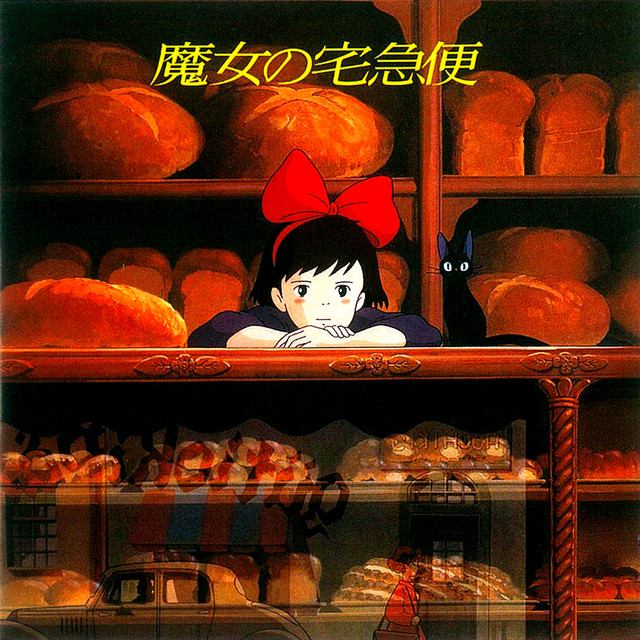
Album: 魔女の宅急便 イメージアルバム
What happens when a composer creates music before the animation exists? For Joe Hisaishi’s work on Studio Ghibli’s ‘Kiki’s Delivery Service,’ this unconventional approach led to one of anime’s most beloved soundtracks, beginning with raw musical sketches that would later bloom into orchestral magnificence.
Among these early explorations was ‘Sekai-tte Hiroi wa’ (‘The World Is So Wide’), a piece from the image album that perfectly captures Hisaishi’s initial vision for the film. Before any final animation was completed, this track served as a musical blueprint, painting the emotional landscape of young Kiki’s journey into independence.
The creation of this image album represents a fascinating glimpse into Hisaishi’s creative process. Working under intense time pressure—with his solo album recording sessions in New York overlapping with the Ghibli project—he collaborated closely with directors Hayao Miyazaki and Isao Takahata to map out which scenes would require music. This pre-planning approach was revolutionary for its time, treating music not as an afterthought but as an integral part of storytelling from the earliest stages.
‘Sekai-tte Hiroi wa’ embodies the album’s core aesthetic philosophy: ‘somehow European, somewhere around the Mediterranean.’ Hisaishi deliberately crafted a soundscape that evoked this region without being tied to any specific location. The track features his characteristic synthesizer work as the foundation, with delicate violin lines and subtle percussion that suggest cobblestone streets and coastal breezes. This instrumentation creates what Hisaishi called a ‘rough sketch’ quality—simple yet emotionally direct.
The piece showcases Hisaishi’s genius for melody creation in its purest form. Without the complexity of full orchestration, the synthesizer arrangement allows each melodic phrase to breathe and resonate. The track moves in a gentle 4/4 tempo, primarily centered in C major, with harmonic progressions that feel both nostalgic and forward-looking—perfectly capturing Kiki’s emotional state as she leaves home for her year of independence.
What makes ‘Sekai-tte Hiroi wa’ particularly significant is its nearly one-to-one correspondence with the final film’s soundtrack. Unlike many image albums that bear little resemblance to their finished counterparts, Hisaishi’s sketches proved so perfectly aligned with the directors’ vision that only two tracks from the entire collection went unused in the final film. This remarkable synchronization speaks to the deep collaborative relationship between composer and filmmakers.
The track exemplifies Hisaishi’s innovative use of ‘breath instruments’—those that require wind to create sound. Though the image album version relies heavily on synthesizers, the underlying composition anticipates the ocarina, accordion, and woodwind instruments that would later dominate the film’s score. These instruments weren’t chosen arbitrarily; they represent the very essence of Kiki’s story. Breath equals wind, and wind represents both the air currents that carry Kiki through the sky and the life force that drives her journey.
In ‘Sekai-tte Hiroi wa,’ we can hear the seeds of this philosophy. The melodic lines seem to float and breathe, rising and falling like natural wind patterns. The synthesizer tones are carefully chosen to suggest organic breath rather than mechanical precision. Even in this electronic incarnation, Hisaishi was thinking about air, movement, and the vital energy of a young witch discovering her place in the world.
The track’s title itself—’The World Is So Wide’—captures the overwhelming sense of possibility and uncertainty that defines Kiki’s adventure. Musically, Hisaishi achieves this through expansive melodic intervals and harmonic progressions that seem to stretch toward the horizon. The piece never feels confined or claustrophobic; instead, it opens like a panoramic view from a broomstick high above the earth.
For European listeners, ‘Sekai-tte Hiroi wa’ offers a fascinating perspective on how Japanese composers interpret European musical sensibilities. Hisaishi doesn’t simply imitate classical European forms; instead, he creates something new—a musical language that speaks to universal emotions while maintaining its distinctly Japanese artistic sensibility.
Listening to this image album track today, we can appreciate it both as a standalone piece and as a window into Hisaishi’s creative process. It represents music in its most essential form: pure melody and emotion, unencumbered by the technical demands of film synchronization. In many ways, these sketches capture something that even the magnificent orchestral versions cannot—the raw creative energy of a master composer imagining new worlds through sound.
‘Sekai-tte Hiroi wa’ reminds us that the most powerful music often begins with the simplest ideas: a melody that captures the feeling of wind beneath wings, a harmony that suggests endless possibilities, and a rhythm that matches the heartbeat of adventure.
- かあさんのホウキRead Review
- ナンパ通りRead Review
- 町の夜Read Review
- 元気になれそうRead Review
- 渚のデイトRead Review
- 風の丘Read Review
- トンボさんRead Review
- リリーとジジRead Review
- 世界って広いわNow Playing
- パン屋さんの窓Read Review
- 突風Read Review
- 木洩れ陽の路地Read Review