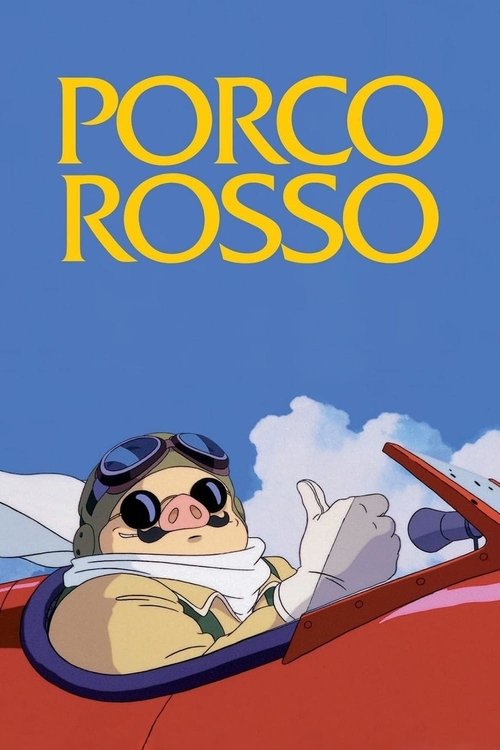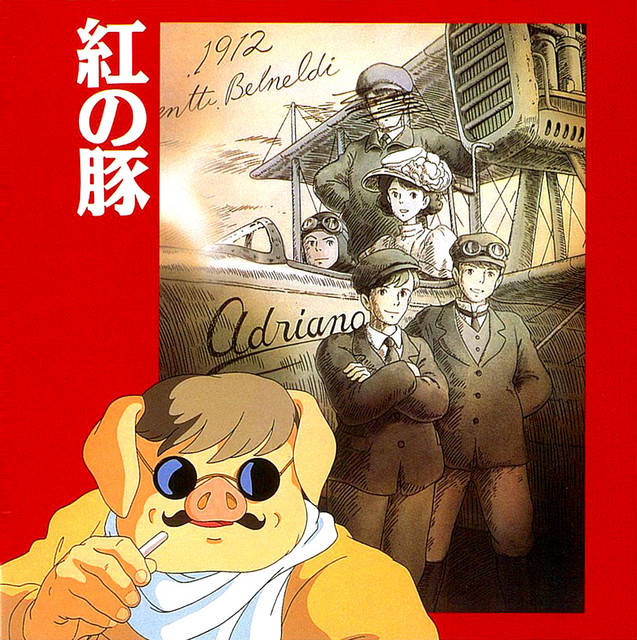
Album: 紅の豚 イメージアルバム
Picture this: Japan’s most celebrated animation director walks into a recording studio and makes perhaps the most unusual musical request in cinema history. ‘Please make embarrassing music for me,’ Hayao Miyazaki told Joe Hisaishi while developing the soundtrack for Porco Rosso. ‘Make it exciting.’ What emerged from this bizarre directive was not just a film score, but a window into one of the most fascinating composer-director partnerships in modern cinema.
The song ‘Bōken Hikōka no Jidai’ (Age of Adventure Pilots) from the Porco Rosso Image Album represents far more than background music for an animated film about flying boats over the Adriatic Sea. It embodies Hisaishi’s unique ability to channel Miyazaki’s abstract vision into concrete musical emotion, drawing from an unexpected well of jazz influences that most fans never associate with Studio Ghibli’s orchestral soundscapes.
To understand how this particular piece came to life, we need to travel back to the early 1990s, when Miyazaki handed Hisaishi six poems as creative inspiration. These weren’t typical film notes or character descriptions, but poetic fragments with titles like ‘Flying Boatmen’s Tango,’ ‘Ascension,’ ‘Twilight Adriatic Sea,’ and ‘Night Flight.’ Imagine trying to compose music from such ethereal prompts – it’s like being asked to paint a sound or sculpt a feeling.
What made Hisaishi uniquely qualified for this challenge wasn’t just his classical training or his growing reputation as an orchestral composer. Hidden beneath his minimalist credentials was a deep love affair with jazz that few people knew about. Since his university days, Hisaishi had been absorbing the music of Miles Davis, John Coltrane, and particularly pianist Mal Waldron, whose influence on his harmonic language would prove enormous.
‘Bōken Hikōka no Jidai’ showcases this jazz sensibility in ways that most listeners miss on first hearing. While the piece maintains the sweeping, cinematic quality expected from a Ghibli soundtrack, its underlying chord progressions and rhythmic patterns reveal Hisaishi’s jazz vocabulary at work. The composition moves through unexpected harmonic territories, much like Waldron’s introspective piano explorations, while maintaining enough forward momentum to capture the adventure and romance of 1930s aviation.
The Image Album served as Hisaishi’s creative laboratory, a space where he could experiment with musical ideas before committing to the final film score. Three major themes from this album – including the prototype for ‘The Days We Can Never Return’ and ‘Flying Boatmen’ – would eventually migrate into the finished film, but in their original Image Album forms, they possessed a rawer, more experimental quality. ‘Bōken Hikōka no Jidai’ represents this exploratory phase, where Hisaishi could indulge his jazz influences more freely.
When recording time came in May and June 1992 at Aoi Studio, Hisaishi made a crucial decision that would define the entire Porco Rosso sound. Despite the growing popularity of synthesizers and digital recording, he insisted on an acoustic approach, assembling a 70-piece full orchestra. This wasn’t mere nostalgia – it was a deliberate choice to match the film’s 1930s setting with period-appropriate instrumentation, while allowing the subtle jazz harmonies to breathe through real brass and woodwind sections.
The result of Miyazaki’s ’embarrassing music’ request becomes clear when you hear ‘Bōken Hikōka no Jidai’ in context. The piece captures something genuinely vulnerable – the romantic foolishness of men who risk their lives flying primitive aircraft over beautiful but dangerous waters. It’s music that admits to sentimentality without shame, that embraces the kind of grand emotions that cynical adults often suppress.
Hisaishi’s genius lies in his ability to transform Miyazaki’s seemingly impossible creative briefs into musical reality. Where another composer might have been confused by requests for ’embarrassing’ music, Hisaishi understood that Miyazaki was asking for emotional honesty – the kind of unguarded feeling that makes audiences laugh and cry simultaneously.
Listening to ‘Bōken Hikōka no Jidai’ today, we hear not just a soundtrack cue but a musical philosophy in action. It demonstrates how jazz sensibilities can enhance orchestral composition, how personal influences can serve universal themes, and how the most unusual creative challenges often produce the most memorable results. When Miyazaki heard the finished piece, his delight confirmed that sometimes the best way to get exactly what you want is to ask for something completely different.
This is the alchemy of collaboration at its finest – one artist’s abstract poetry transformed into another’s concrete music, creating something neither could have achieved alone.
- アドリア海の青い空Read Review
- 冒険飛行家の時代Now Playing
- 真紅の翼Read Review
- 雲海のサボイアRead Review
- ピッコロ社Read Review
- 戦争ゴッコRead Review
- ダボハゼRead Review
- アドリアーノの窓Read Review
- 世界恐慌Read Review
- マルコとジーナのテーマRead Review