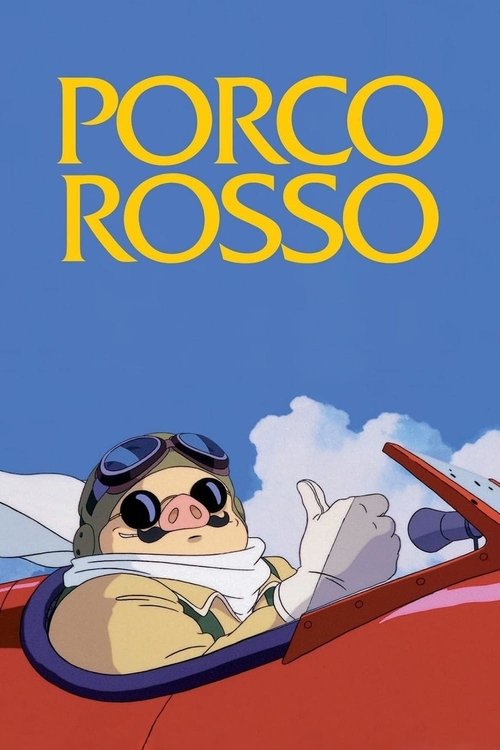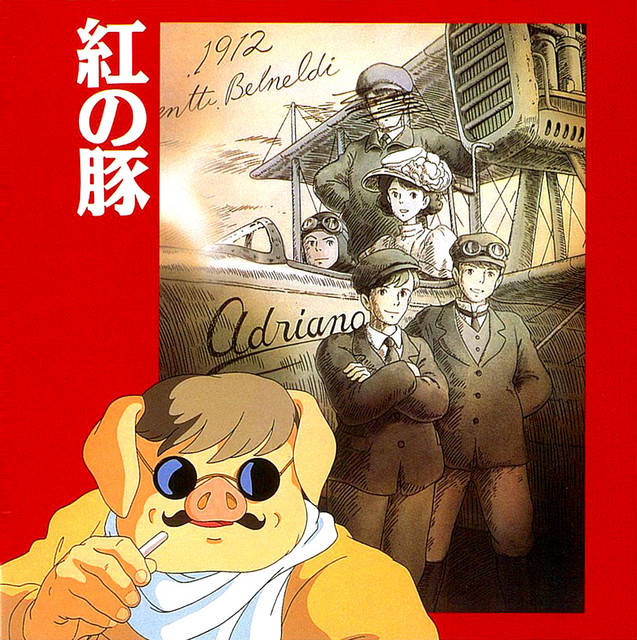
Album: 紅の豚 イメージアルバム
In the smoky cafes of 1920s Europe, where jazz was reshaping musical consciousness, an unlikely connection was forming between two Japanese artists decades later. Joe Hisaishi’s composition ‘Adriano’s Window’ from the Porco Rosso Image Album represents more than just another Studio Ghibli soundtrack piece—it embodies a moment when creative destiny aligned with artistic intuition.
The story begins with what Hisaishi himself described as a ‘fateful coincidence.’ While working on the image album for Porco Rosso, he was simultaneously crafting his solo album ‘My Lost City,’ inspired by F. Scott Fitzgerald’s literary world and set in the 1920s. When Hayao Miyazaki chose the same era for his tale of the cursed pilot Marco Rosellini, Hisaishi felt the hand of artistic fate. ‘As artists living in the same era, I felt something very destined about this,’ he reflected.
‘Adriano’s Window’ emerges from this convergence of vision. The piece, likely written in a contemplative B-flat major with its characteristic warmth, captures the melancholic romance of interwar Europe through Hisaishi’s unique lens. The composition features delicate piano passages that echo the influence of jazz pianist Mal Waldron, whose work had profoundly shaped Hisaishi’s musical vocabulary since his student days. Those familiar with Hisaishi primarily as an orchestral composer might be surprised by his deep jazz roots—he was an avid listener of Miles Davis, John Coltrane, and particularly Waldron, whose piano style left an indelible mark on his harmonic sensibilities.
The image album served as Hisaishi’s creative laboratory, where three major themes would eventually migrate to the final film score: ‘Days of Youth’ evolved from ‘Marco and Gina’s Theme,’ ‘Flying Boatmen’ grew from ‘Dabohaze,’ and ‘Piccolo’s Women’ developed from ‘Piccolo Company.’ ‘Adriano’s Window,’ while perhaps not making this direct transition, represents the experimental spirit that characterized this preparatory phase.
Miyazaki’s reaction to ‘My Lost City’ reveals the depth of their artistic synchronicity. Upon hearing the completed album, the director declared he wanted ‘all of those songs, everything for Porco Rosso.’ This wasn’t mere enthusiasm—it was recognition of a shared aesthetic vision. The opening sequence would indeed be conceived with ‘My Lost City’s’ track ‘1920~Age of Illusion’ in mind, while the canal takeoff scene would directly incorporate ‘Madness.’
‘Adriano’s Window’ benefits from this cross-pollination between Hisaishi’s solo work and his film scoring. The piece likely features the subtle jazz harmonies and rhythmic sophistication that distinguish the Porco Rosso score from earlier Ghibli works. Where previous collaborations drew primarily from classical and folk traditions, this project introduced two revolutionary elements: authentic jazz language and the integration of pre-existing solo compositions into the film score framework.
The technical aspects of ‘Adriano’s Window’ reflect Hisaishi’s jazz education. The harmonic progressions show Waldron’s influence—those slightly dissonant chord voicings that suggest melancholy without overwhelming the melodic line. The tempo marking would likely be a relaxed moderato, allowing space for the kind of rubato phrasing that jazz musicians use to express emotional nuance. Instrumentation probably centers on piano with subtle orchestral colors—perhaps muted brass or solo woodwinds—creating an intimate cafe atmosphere.
This piece exists within a broader narrative about artistic maturation. By 1992, Hisaishi had moved beyond the purely minimalist approaches of his earlier career, incorporating his diverse musical influences into a more sophisticated compositional voice. ‘Adriano’s Window’ represents this evolution—it’s neither purely classical nor purely jazz, but something uniquely Hisaishi.
The image album concept itself deserves recognition as a creative strategy. These preparatory works allowed Hisaishi to explore musical territories without the constraints of specific scene timings or narrative requirements. ‘Adriano’s Window’ could breathe, develop its own internal logic, and establish emotional territories that would inform the final score even if the piece itself didn’t appear in the film.
Listening to ‘Adriano’s Window’ today, we hear the sound of two artistic visions converging across time and cultural boundaries. Hisaishi’s 1920s-obsessed solo album meets Miyazaki’s aviation romance, mediated by the composer’s jazz-influenced harmonic language and his gift for melodic storytelling. The result is music that captures both the period’s romantic idealism and its underlying melancholy—perfect preparation for a story about a pilot cursed to live as a pig, searching for redemption in the skies above the Adriatic Sea.
In this convergence of jazz sophistication and animated storytelling, ‘Adriano’s Window’ stands as evidence of how great film music emerges not from assignment, but from the mysterious alignment of artistic destinies.
- アドリア海の青い空Read Review
- 冒険飛行家の時代Read Review
- 真紅の翼Read Review
- 雲海のサボイアRead Review
- ピッコロ社Read Review
- 戦争ゴッコRead Review
- ダボハゼRead Review
- アドリアーノの窓Now Playing
- 世界恐慌Read Review
- マルコとジーナのテーマRead Review