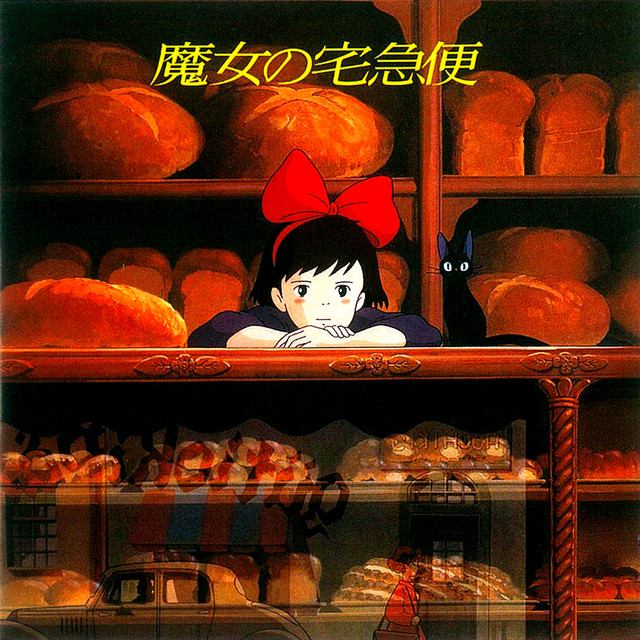
Album: 魔女の宅急便 イメージアルバム
Inside a modest Tokyo studio, Joe Hisaishi sat at his synthesizer, sketching musical landscapes for a young witch who hadn’t yet learned to fly. The track “Kaa-san no Houki” (Mother’s Broom) from the Kiki’s Delivery Service Image Album represents something extraordinary in film music: a composer and director so perfectly aligned in their vision that rough musical sketches would translate almost note-for-note into cinematic gold.
The Image Album for Kiki’s Delivery Service stands as one of cinema’s most fascinating creative documents. Unlike typical film scores written after footage is complete, Hisaishi composed these pieces as musical storyboards, working closely with Hayao Miyazaki to establish the emotional architecture of their magical world. The remarkable result? Nearly every track from the Image Album found its way into the final film, with only two pieces left unused. This extraordinary one-to-one correspondence reveals the depth of collaboration between two artists who understood that music wasn’t just accompaniment—it was the very breath of their story.
“Mother’s Broom” exemplifies Hisaishi’s approach to this preliminary musical sketching. Built around simple synthesizer arrangements, the piece captures something that elaborate orchestration might have obscured: the pure essence of melody. Without the complexity of a full orchestra, every note serves a purpose, every phrase carries emotional weight. The track pulses with a gentle, nostalgic rhythm that suggests both the mechanical sweep of a broom and the supernatural grace of flight.
Hisaishi’s inspiration drew from “somewhere European, perhaps around the Mediterranean,” and this geographic imagination permeates “Mother’s Broom.” The melody carries hints of European folk traditions—not through literal quotation, but through an emotional resonance that feels both familiar and enchanted. Synthesized strings dance around a central theme played on what sounds like an accordion or concertina, instruments that embody Hisaishi’s philosophy about breath-powered instruments representing life force itself.
This focus on wind instruments reveals Hisaishi’s deeper understanding of Kiki’s story. Throughout his score, he employs ocarinas, accordions, and woodwinds—instruments that require breath, that transform air into music. For a story about a young witch learning to fly, this choice becomes metaphorically perfect. Breath equals wind equals the very element that carries Kiki through the sky. In “Mother’s Broom,” these breathy timbres suggest not just the physical act of sweeping, but the spiritual inheritance passed from mother to daughter.
The track’s instrumentation reflects Hisaishi’s belief in accessible, singable melodies. “First, it must be something you can sing loudly,” he once explained about his approach to Miyazaki’s films. “Nothing pretentiously clever, but thoroughly returning to childlike innocence and creating something completely straightforward.” “Mother’s Broom” embodies this philosophy—its main melody could easily be hummed by a child, yet carries sophisticated harmonic progressions that reward deeper listening.
Set in a comfortable mid-tempo, the piece moves like a gentle waltz, its triple meter evoking both domestic routine and magical transformation. The key appears to be in a major mode, suggesting hope and possibility, while subtle minor inflections add emotional complexity. This musical duality mirrors Kiki’s own journey—the comfort of home memory intertwined with the uncertainty of independence.
What makes “Mother’s Broom” particularly remarkable is how it functions as both standalone composition and narrative element. As part of the Image Album’s rough sketch aesthetic, it captures the essence of maternal love and inherited power without over-explaining. The broom isn’t just a magical object; it’s a connection across generations, a tool transformed into transportation, a symbol of both mundane domestic life and extraordinary possibility.
Hisaishi’s human-centered approach to composition shines through this piece’s warm, enveloping sound. His commitment to “human love” in his music means that even magical elements feel grounded in recognizable emotion. “Mother’s Broom” doesn’t sound otherworldly so much as it sounds like home remembered from a distance—comforting, slightly melancholy, and infinitely precious.
The track’s place in the Image Album also demonstrates Hisaishi’s remarkable ability to compose narrative music before seeing final visuals. Working from Miyazaki’s concepts and early sketches, he created not just accompaniment but musical storytelling that would guide the film’s emotional rhythm. When “Mother’s Broom” eventually appeared in the finished film, it had already established the perfect emotional temperature for Kiki’s relationship with her magical inheritance.
Listening to “Mother’s Broom” today, we hear the sound of two master storytellers finding their shared language. Every synthesized note represents hours of creative conversation, every melodic phrase a mutual understanding about the heart of their story. In its deceptively simple arrangement lies the blueprint for one of cinema’s most beloved musical landscapes—proof that sometimes the most profound magic happens in the sketches, before the world gets too complicated to hear the essential song.
- かあさんのホウキNow Playing
- ナンパ通りRead Review
- 町の夜Read Review
- 元気になれそうRead Review
- 渚のデイトRead Review
- 風の丘Read Review
- トンボさんRead Review
- リリーとジジRead Review
- 世界って広いわRead Review
- パン屋さんの窓Read Review
- 突風Read Review
- 木洩れ陽の路地Read Review