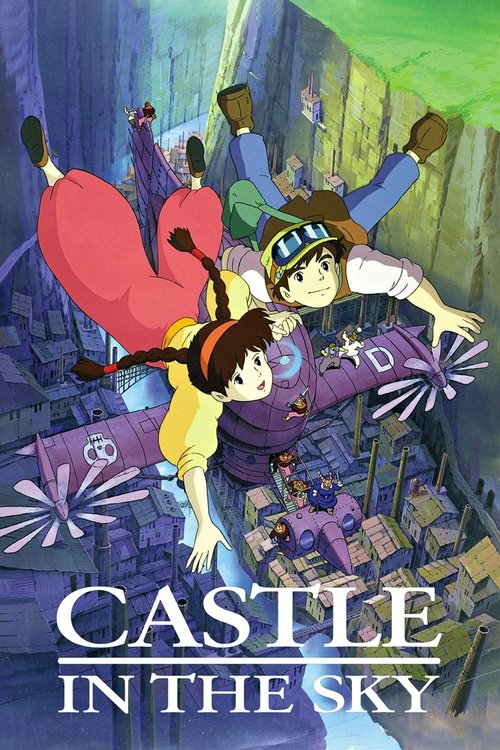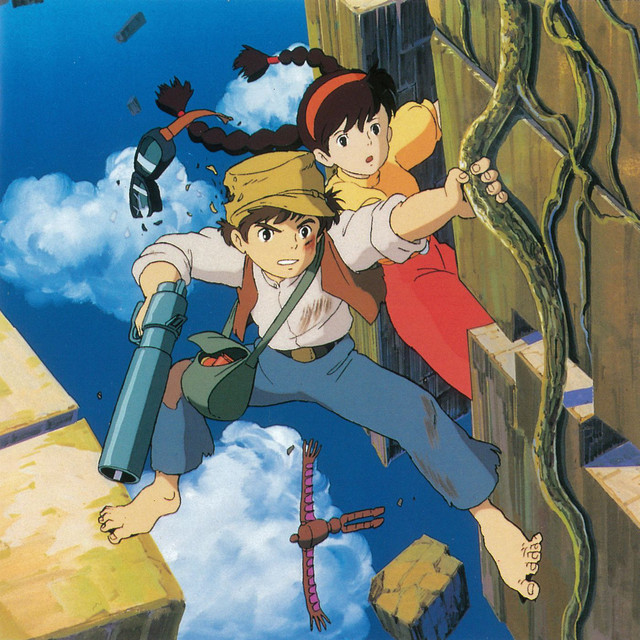
Album: 天空の城ラピュタ サウンドトラック ~飛行石の謎~
In the summer of 1986, composer Joe Hisaishi faced an unprecedented challenge that would reshape his approach to film scoring forever. Working on the soundtrack for Hayao Miyazaki’s “Castle in the Sky” (Tenkū no Shiro Rapyuta), Hisaishi committed himself to achieving something remarkable: perfect synchronization between musical flow and animated movement. The song “Sora kara Futtekita Shōjo” (The Girl Who Fell from the Sky) stands as a prime example of this revolutionary methodology.
Hisaishi’s declaration was bold and uncompromising: “This time, I want to thoroughly focus on matching the movement of the pictures with the flow of the music.” This wasn’t merely about creating atmospheric background music; it was about engineering a seamless fusion where every musical phrase would correspond precisely to the visual action unfolding on screen.
The technical process behind “The Girl Who Fell from the Sky” reveals the meticulous nature of this approach. Using rush film videos, Hisaishi and his team calculated exact timing points for visual movements, feeding this data into a Fairlight III synthesizer to construct the foundational rhythmic framework. This piece, composed in a gentle 4/4 time signature with flowing sixteenth-note passages, demonstrates how mathematical precision could serve emotional storytelling.
The creative timeline was remarkably compressed yet efficient. By June 20, the complete rush film was nearly finished, setting the stage for intense collaboration. Three days later, in a coffee shop near Studio Ghibli, Hisaishi sat down with Miyazaki and producer Isao Takahata for crucial discussions about the background music direction. These conversations, grounded in the previously created image album, shaped the sonic landscape of the entire film.
“The Girl Who Fell from the Sky” embodies Hisaishi’s musical DNA in fascinating ways. The composer has often reflected on how his melodic sensibilities align closely with Scottish and Irish folk traditions, and this particular piece showcases those Celtic influences through its lilting, modal progressions. The melody rises and falls like traditional ballads, creating an immediate sense of wonder and mystery that perfectly captures the moment when Sheeta descends from the sky.
This connection to folk traditions wasn’t accidental. Hisaishi has described Laputa as existing in a musical space naturally close to his own artistic origins. His university experience conducting Baroque ensembles also informed his work, contributing to what he calls the “Renaissance-like brightness” heard in Pazu’s trumpet themes and, by extension, the optimistic undertones that permeate “The Girl Who Fell from the Sky.”
Miyazaki’s creative briefings provided crucial emotional context for the composition. For scenes depicting the mining town inhabitants, the director painted vivid character sketches: hardworking people who believed that tomorrow might bring better fortune, whose strength exceeded the weight of their pickaxes, whose solidarity expressed itself through shared drinks and generous spirits. While “The Girl Who Fell from the Sky” doesn’t directly score these mining sequences, the underlying philosophy of resilience and hope infuses the musical language Hisaishi developed for the entire soundtrack.
The orchestral arrangement process began on June 24 at Wonder Station, where Hisaishi constructed rhythmic foundations using the Fairlight III. The full orchestral recording took place on July 8 at Nikkatsu Studio, featuring nearly fifty musicians whose performance brought the delicate interplay of strings, woodwinds, and brass to life. The track’s instrumentation centers around a string section that carries the main melodic line, supported by gentle woodwind harmonies and occasional brass punctuation that suggests both earthiness and transcendence.
By July 12, the complete soundtrack was mixed down, but “The Girl Who Fell from the Sky” represented more than just another cue in the film’s musical tapestry. It embodied Hisaishi’s revolutionary approach to anime scoring, where music didn’t simply accompany action but became intrinsically woven into the visual narrative structure.
The piece operates in a major key that shifts subtly between related modes, creating harmonic movement that mirrors Sheeta’s gentle descent. Hisaishi’s use of sustained strings underneath flowing melodic lines creates the sensation of floating or falling, while rhythmic elements provide just enough forward momentum to maintain narrative drive without overwhelming the scene’s dreamlike quality.
This meticulous attention to visual-musical synchronization influenced countless anime composers who followed. Hisaishi’s method of using precise timing calculations to inform musical structure became a template for creating truly cinematic animation scores, where music serves not as decoration but as integral storytelling architecture.
“The Girl Who Fell from the Sky” ultimately demonstrates how technical innovation can serve emotional expression. Through frame-perfect synchronization, Celtic-influenced melody, and orchestral craftsmanship, Hisaishi created a piece that captures both the specific moment of Sheeta’s arrival and the broader themes of wonder, destiny, and human connection that define Castle in the Sky’s enduring appeal.
- 空から降ってきた少女Now Playing
- スラッグ溪谷の朝Read Review
- 愉快なケンカ(~追跡)Read Review
- ゴンドアの思い出Read Review
- 失意のパズーRead Review
- ロボット兵(復活~救出)Read Review
- 合唱 君をのせてRead Review
- シータの決意Read Review
- タイガーモス号にてRead Review
- 破滅への予兆Read Review
- 月光の雲海Read Review
- 天空の城ラピュタRead Review
- ラピュタの崩壊Read Review
- 君をのせてRead Review