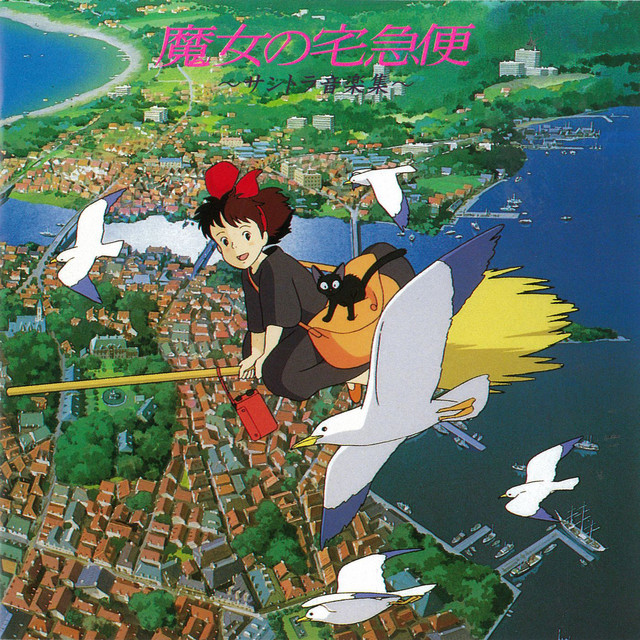
Album: 魔女の宅急便 サントラ音楽集
In the quiet moments of Kiki’s Delivery Service, when the young witch loses her powers and questions her very identity, something extraordinary happens through sound. Joe Hisaishi’s composition “Shinpiteki na E” (The Mysterious Painting) emerges not just as background music, but as musical therapy—a sonic representation of the human capacity for self-healing and renewal.
This pivotal track plays during one of the film’s most emotionally charged scenes: when Ursula, the forest-dwelling artist, encourages a dejected Kiki to rediscover her strength. What makes this moment particularly striking is Hisaishi’s choice of instrumentation. Rather than relying on his usual orchestral palette, he centers the composition around an ocarina-style synthesizer, creating what sounds like an ancient voice calling across centuries.
The decision to feature this particular timbre wasn’t accidental. Hisaishi understood that the ocarina’s earthy, breathy sound carries something primal—a connection to humanity’s earliest musical expressions. The instrument’s voice seems to emerge from the earth itself, representing what he called “the source of life” and the natural human ability to heal from within.
This composition perfectly exemplifies Hisaishi’s broader artistic philosophy for the Kiki’s Delivery Service soundtrack. When the project began, he faced extraordinary time constraints that would make modern composers break into cold sweats. After a month-long interruption due to his New York recording commitments, Hisaishi returned to Japan and had mere days to complete additional compositions and arrangements. The day after his return, he attended project meetings; two days later, he was in the recording studio with a full orchestra. This impossible timeline—finishing everything by early July for the film’s July 29th nationwide release—forced him to work on pure instinct.
Yet these constraints may have paradoxically liberated his creativity. For this project, Hisaishi deliberately moved away from synthesizer-heavy arrangements, seeking what he called “sounds closer to live performance.” He wanted the music to feel as real and grounded as Kiki’s coming-of-age story itself. This shift toward organic instrumentation created space for instruments that require breath—the very element that powers flight.
Throughout the entire Kiki soundtrack, Hisaishi employed what could be called a “breath-based” instrumental philosophy. Ocarinas, accordions, and woodwinds dominate the musical landscape, all instruments that require the player to breathe life into them. This wasn’t merely an aesthetic choice; it was symbolic storytelling through sound. Breath equals wind, and wind represents the air currents that carry Kiki through the sky, the atmospheric essence of Koriko town, and most importantly, Kiki’s own life force.
“Shinpiteki na E” embodies this philosophy perfectly. The ocarina-style synthesizer breathes with an almost human quality, rising and falling like sighs of relief or gentle encouragement. The melody moves in simple, reassuring phrases that feel like a musical embrace—exactly what Kiki needs in her moment of doubt.
Hisaishi’s European musical influences also shine through this composition. Drawing inspiration from Mediterranean folk traditions and European dance forms, he crafted melodies that feel both ancient and immediate. The three-quarter time signatures that characterize much of the soundtrack create a waltz-like quality that suggests movement and renewal. Even in “Shinpiteki na E,” there’s an underlying rhythmic pulse that seems to say: life goes on, healing happens, strength returns.
The use of European folk instruments like the dulcimer (piano’s ancestral cousin), guitar, and accordion throughout the album created what Hisaishi described as “European ethnic and dance-like” atmospheres. But “Shinpiteki na E” stands apart by focusing on the most elemental voice of all—the ocarina, an instrument that predates European folk traditions entirely.
What makes this composition particularly powerful is how it functions as both intimate character development and universal statement. On one level, it’s specifically Ursula’s musical voice encouraging Kiki. But on another level, it speaks to anyone who has ever faced creative blocks, self-doubt, or the feeling of losing something essential about themselves.
The track’s gentle tempo and warm tonal palette create what psychologists might recognize as a “safe space” in sound. There’s no urgency here, no demand for immediate resolution. Instead, Hisaishi offers musical patience—the kind of compassion that allows healing to happen naturally.
In our age of digital music production and endless sonic possibilities, “Shinpiteki na E” reminds us that sometimes the most profound musical statements come from the simplest sources. An ancient instrument’s voice, filtered through modern technology but retaining its primordial essence, becomes a bridge between past and present, between struggle and hope.
This is Joe Hisaishi at his most philosophical: using music not just to accompany a story, but to embody its deepest truths about resilience, renewal, and the mysterious power of human connection to heal what seems irreparably broken.
- 晴れた日に…Read Review
- 旅立ち
- 海の見える街Read Review
- 空とぶ宅急便Read Review
- パン屋の手伝いRead Review
- 仕事はじめRead Review
- 身代わりジジRead Review
- ジェフRead Review
- 大忙しのキキRead Review
- パーティーに間に合わないRead Review
- オソノさんのたのみ事…Read Review
- プロペラ自転車Read Review
- とべない!Read Review
- 傷心のキキRead Review
- ウルスラの小屋へRead Review
- 神秘なる絵Now Playing
- 暴飛行の自由の冒険号Read Review
- おじいさんのデッキブラシRead Review
- デッキブラシでランデブーRead Review