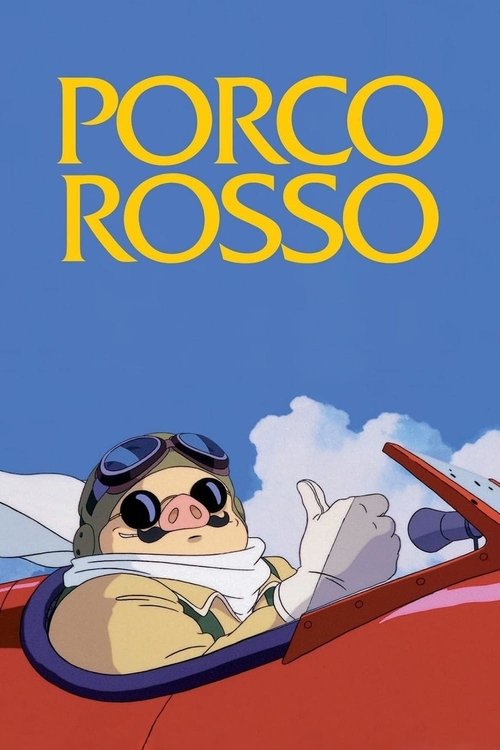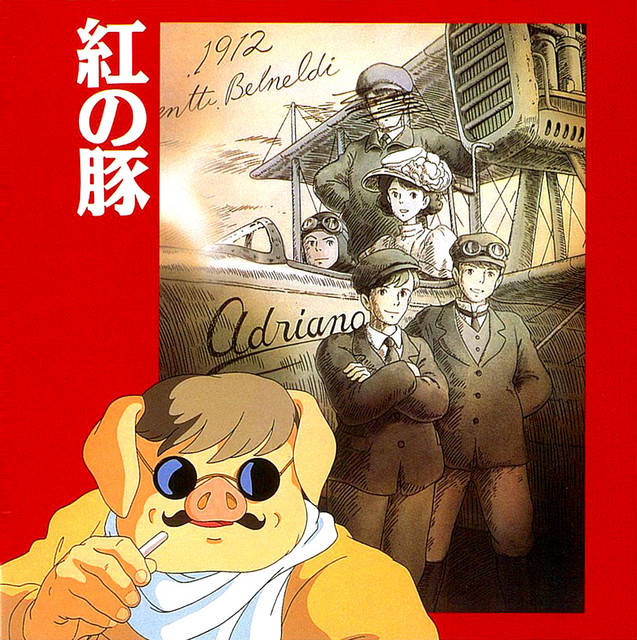
Album: 紅の豚 イメージアルバム
Behind every Studio Ghibli film lies a musical conversation between director and composer that shapes the very soul of the story. For Porco Rosso, this dialogue between Hayao Miyazaki and Joe Hisaishi produced one of anime’s most distinctive soundscapes—one where jazz sensibilities meet orchestral grandeur in unexpected ways. At the heart of this creative process stands ‘Sekai Kyōkō’ (World Panic), a track from the film’s image album that reveals the fascinating cross-pollination of musical influences that defined the project.
The genesis of Porco Rosso’s musical identity began not with melodies, but with poetry. Miyazaki handed Hisaishi six poems as creative touchstones: ‘Flying Boatman’s Tango,’ ‘Ascension,’ ‘Twilight on the Adriatic Sea,’ ‘Night Flight,’ ‘Secret Garden,’ and ‘Merry-Go-Round.’ These verses served as emotional blueprints, helping the composer understand the film’s atmospheric intentions before a single frame was animated. This collaborative approach highlights how Hisaishi’s music emerges from deep narrative understanding rather than mere technical craft.
What makes ‘Sekai Kyōkō’ particularly intriguing is how it embodies the duality at the center of Hisaishi’s musical personality. While many know him primarily as an orchestral composer and minimalist pioneer, his formative years were steeped in jazz. From his student days, he absorbed the innovations of Miles Davis, John Coltrane, and especially Mal Waldron, whose piano techniques left an indelible mark on his harmonic thinking. This jazz foundation surfaces throughout Porco Rosso’s score, lending it a sophisticated rhythmic complexity that distinguishes it from other Ghibli soundtracks.
The track exemplifies how Hisaishi translates jazz vocabulary into orchestral language. Built around a restless, syncopated rhythm that mirrors the economic upheaval its title suggests, ‘Sekai Kyōkō’ employs chromatic harmonies reminiscent of Waldron’s angular piano work. The piece moves through shifting time signatures with the fluid unpredictability of a jazz standard, yet maintains the melodic accessibility that Ghibli films demand. This balance between sophistication and immediacy became a hallmark of the Porco Rosso soundtrack.
Miyazaki’s creative brief for the project was characteristically unconventional: ‘Please make embarrassing music and get everyone excited.’ Producer Toshio Suzuki recalled how this seemingly contradictory request perfectly captured the film’s nostalgic romanticism—the kind of earnest emotion that might feel ’embarrassing’ in its sincerity yet proves utterly compelling. Hisaishi’s response delighted Miyazaki, who recognized that the composer had found the precise emotional register the film required.
The recording process for Porco Rosso marked a significant technical evolution for Hisaishi. Determined to achieve an authentic acoustic sound, he arranged for a full 70-piece orchestra to record at Aoi Studio between May and June 1992. This commitment to live performance rather than synthesized sounds reflects his belief that human musical expression carries emotional nuances that technology cannot replicate. For ‘Sekai Kyōkō,’ this approach brings out the subtle dynamic shifts and instrumental color changes that make the piece feel alive and breathing.
The image album format itself provided Hisaishi with creative freedom that would prove crucial to the film’s eventual success. Three major themes from this preliminary recording—the prototypes for ‘Days of Bygone,’ ‘Flying Boatmen,’ and ‘Piccolo’s Women’—survived intact into the final film score. This suggests that ‘Sekai Kyōkō’ and its companion pieces captured something essential about the story’s spirit even before the animation was complete.
Listening to ‘Sekai Kyōkō’ today, one can hear how Hisaishi’s jazz influences inform his approach to orchestration. The interplay between wind and string sections echoes the conversational nature of small jazz ensembles, while unexpected harmonic turns keep listeners engaged in ways that purely classical arrangements might not. The piece operates in a minor key that evokes both melancholy and urgency, perfectly capturing the economic anxiety its title suggests while maintaining the romantic escapism that defines Porco Rosso’s world.
This musical approach reflects Hisaishi’s broader philosophy of composition: that film music should support narrative without overwhelming it, providing emotional context while allowing space for the story to breathe. By drawing on his jazz background, he brings rhythmic sophistication and harmonic complexity to what might otherwise be straightforward orchestral themes. The result is music that rewards both casual listening and deeper analysis—accessible enough for children yet rich enough to sustain adult attention through multiple viewings.
The success of ‘Sekai Kyōkō’ and the broader Porco Rosso soundtrack demonstrates how creative constraints can spark innovation. Miyazaki’s poetic guidelines and seemingly contradictory requests pushed Hisaishi toward musical solutions he might not have discovered otherwise. The jazz influences that some might consider peripheral to his orchestral work actually prove central to his distinctive voice as a film composer. In bridging these worlds, Hisaishi created a musical language that feels both timeless and utterly contemporary—much like the films themselves.
- アドリア海の青い空Read Review
- 冒険飛行家の時代Read Review
- 真紅の翼Read Review
- 雲海のサボイアRead Review
- ピッコロ社Read Review
- 戦争ゴッコRead Review
- ダボハゼRead Review
- アドリアーノの窓Read Review
- 世界恐慌Now Playing
- マルコとジーナのテーマRead Review