
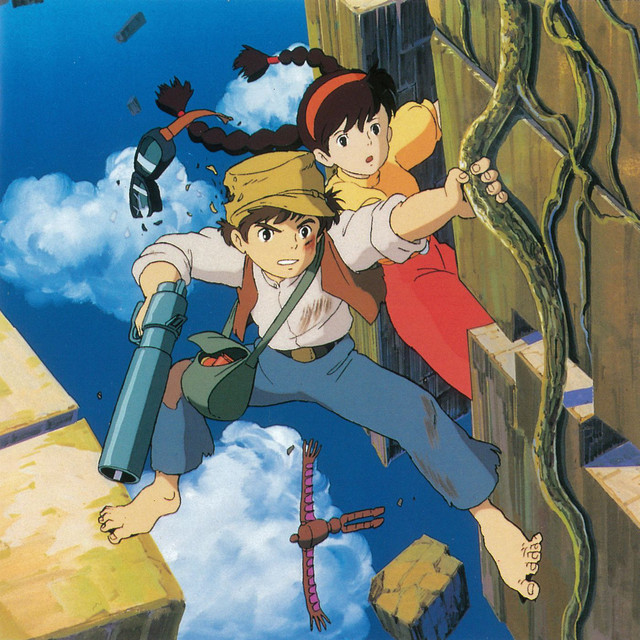
Album: 天空の城ラピュタ サウンドトラック ~飛行石の謎~
When Joe Hisaishi sat down in a Tokyo café with Hayao Miyazaki and Isao Takahata on June 23, 1986, he was about to embark on what he would later describe as a completely unprecedented approach to film scoring. The Castle in the Sky soundtrack represents a fascinating case study in how meticulous preparation and innovative technology can create music that feels both intimately connected to its visual counterpart and emotionally autonomous.
The most striking aspect of Hisaishi’s work on this project wasn’t just the beautiful melodies that emerged, but the radical two-stage composition process he developed. Rather than composing directly to picture, Hisaishi first created an image album called “The Girl Who Fell From the Sky,” establishing the musical DNA of Laputa before a single frame was animated. This meant that when the three collaborators gathered to discuss the actual soundtrack, they already shared a common musical vocabulary. As Hisaishi noted with some pride, “Probably no one else is doing anything like this.”
This preparatory work paid enormous dividends during the intense production schedule that followed. By June 20, the rush film was nearly complete, giving Hisaishi just three weeks to transform his musical concepts into a full orchestral score. The pressure was immense, but the foundation laid by the image album allowed for remarkably specific discussions about which themes belonged in which scenes.
At the heart of Hisaishi’s approach was an obsession with synchronization that bordered on the scientific. Using a Fairlight III synthesizer – cutting-edge technology for 1986 – he meticulously analyzed the rush film footage, noting the exact timing of visual cues down to the second. This data became the rhythmic skeleton upon which he built each cue, ensuring what he called “complete unity between the movement of the pictures and the flow of music.”
Take “Robot Soldier (Revival ~ Rescue),” one of the album’s most technically demanding pieces. Here, Hisaishi’s frame-by-frame approach becomes audible in how the music anticipates and mirrors the mechanical awakening of Laputa’s ancient guardian. The track builds from mysterious whispers to thunderous brass, but every crescendo and sudden silence is calibrated to match specific visual moments. It’s filmmaking by stopwatch, yet the result feels completely organic.
The philosophical foundation underlying this technical precision was surprisingly simple. Hisaishi wanted to create music that would warm children’s hearts – melodies that conveyed “love, dreams, and adventure” in the most direct way possible. This meant abandoning the complex sound sampling he had used in previous works like “Arion” in favor of what he called “simple acoustic sounds.” The decision reflects a broader maturity in his approach: sometimes the most sophisticated choice is to embrace simplicity.
This philosophy reaches its fullest expression in “Carrying You” (Kimi wo Nosete), both in its choral arrangement on the album and as the film’s end theme. Built around a melody that seems to have existed forever, the piece demonstrates Hisaishi’s ability to create music that functions on multiple levels simultaneously. As a standalone listening experience, it’s a gorgeous piece of orchestral writing. Within the film, it becomes the emotional culmination of Pazu and Sheeta’s journey. The genius lies in how these two functions enhance rather than compete with each other.
Miyazaki’s input during the creative process reveals another fascinating dimension of the collaboration. His character notes for Dola – “passion and pride, appetite and greed, overflowing love and hate” – show a director thinking about music in deeply emotional rather than technical terms. These weren’t instructions about instrumentation or tempo, but rather psychological portraits that Hisaishi had to translate into musical language.
The recording sessions themselves tell their own story about the collision between old and new techniques. While Hisaishi spent days at Wonder Station building rhythmic foundations with his Fairlight III, the actual orchestral recording on July 8 at Nikkatsu Studio involved nearly fifty musicians playing traditional instruments. The marriage of digital precision and human expression created a sonic palette that was both contemporary and eternal – perfect for a story about ancient technology in a steampunk world.
When the final mix was completed on July 12, Hisaishi had created something genuinely revolutionary. The Castle in the Sky soundtrack proved that film music could be both technically rigorous and emotionally generous, that synchronization with picture could enhance rather than constrain musical expression. The album stands as perhaps the clearest example of Hisaishi’s unique gift: the ability to make complex technical processes serve simple human emotions.
Listening to these tracks today, what strikes you isn’t the sophisticated production techniques or the innovative composition methods, but how effortlessly the music seems to breathe alongside Miyazaki’s images. That effortlessness, of course, is the product of tremendous effort – the kind of painstaking preparation that allows true spontaneity to emerge. In this sense, the Castle in the Sky soundtrack represents not just a beautiful collection of melodies, but a blueprint for how film music might work at its very best: invisible in its technique, undeniable in its impact.
The album’s enduring popularity suggests that Hisaishi succeeded in his goal of creating music that could warm hearts decades after its creation. More importantly, it established a working method that would influence not just his own future collaborations with Studio Ghibli, but the entire field of animation scoring. Sometimes revolution arrives not with dramatic gestures, but with the quiet determination to do familiar work in an entirely new way.
- 空から降ってきた少女Read Review
- スラッグ溪谷の朝Read Review
- 愉快なケンカ(~追跡)Read Review
- ゴンドアの思い出Read Review
- 失意のパズーRead Review
- ロボット兵(復活~救出)Read Review
- 合唱 君をのせてRead Review
- シータの決意Read Review
- タイガーモス号にてRead Review
- 破滅への予兆Read Review
- 月光の雲海Read Review
- 天空の城ラピュタRead Review
- ラピュタの崩壊Read Review
- 君をのせてRead Review
Sources
- Castle in the Sky Soundtrack Liner Notes
- Castle in the Sky Roman Album
- Castle in the Sky Image Album (Miyazaki Memo)