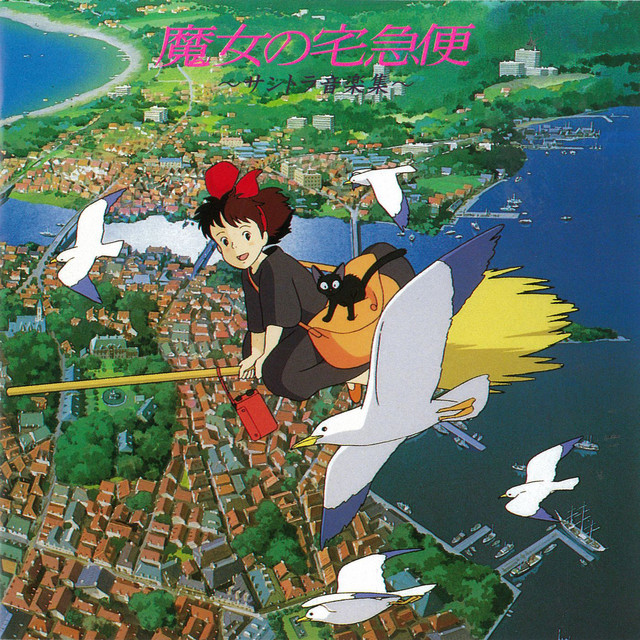
Album: 魔女の宅急便 サントラ音楽集
What happens when a composer must capture the essence of a young witch’s awakening spirit while working under impossible deadlines? Joe Hisaishi faced exactly this challenge when crafting ‘Umi no Mieru Machi’ (A Town with an Ocean View) for the Kiki’s Delivery Service soundtrack, creating one of the most structurally fascinating pieces in his catalog.
The song exists as a musical diptych, split between two distinct worlds that mirror the duality of its protagonist. The opening section draws from Hisaishi’s earlier composition ‘Kaze no Oka’ (Hill of Wind), where woodwinds and pizzicato strings deliver the melody with baroque precision. This isn’t accidental architecture – Hisaishi deliberately structured this portion with Bach-like interludes, creating a sense of order and tradition that reflects Kiki’s grounded, rural origins.
Then comes the transformation. After that carefully orchestrated classical interlude, the piece shifts into what Hisaishi termed his ‘flamenco-style’ arrangement, originally conceived for a section called ‘Nampa Dori’ (Pickup Street). Guitars and castanets suddenly dominate the soundscape, injecting Mediterranean fire into what began as chamber music restraint. This wasn’t mere stylistic flourish – it was Hisaishi’s way of musically depicting Kiki’s burgeoning confidence and vitality as she discovers her place in the wider world.
The creative philosophy behind this dual structure reveals Hisaishi’s approach to character-driven composition. Rather than maintaining sonic consistency throughout the piece, he allowed the music to evolve with Kiki’s emotional journey. The formal, measured opening gives way to passionate expression, mirroring how young people often transition from careful observation to bold participation in life.
This compositional strategy aligned perfectly with director Isao Takahata’s vision for the film’s emotional arc. Takahata specifically requested that the main waltz theme be used repeatedly during moments when ‘Kiki’s feelings gradually expand.’ The challenge for Hisaishi was creating music that could support these pivotal flying sequences without relying on obvious sound effects. His solution was to embed that sense of soaring freedom directly into the musical structure itself.
The Mediterranean influences weren’t coincidental. Hisaishi deliberately moved away from his typical synthesizer-heavy arrangements, explaining that he wanted to ‘reduce synthetic sounds and move closer to live instruments’ for this project. He incorporated dulcimer, accordion, and various European folk instruments to create what he called a ‘Greek-influenced nuance.’ This decision reflected his belief that Kiki’s story demanded more tactile, earthy sounds than his previous electronic compositions.
The prevalence of triple meter throughout the soundtrack also tells a deeper story. Hisaishi noted that ‘dance-like pieces in 3/4 time’ became a defining characteristic of the score. This wasn’t just aesthetic preference – waltz rhythm inherently suggests movement, lifting, the kind of musical gesture that supports a story about learning to fly. ‘A Town with an Ocean View’ exemplifies this approach, with its flowing triple meter creating the sensation of gentle undulation, like ocean waves or wind currents.
Perhaps most remarkably, this intricate musical architecture was created under extraordinary pressure. Hisaishi had been recording in New York when the Kiki project began, forcing a month-long interruption in his work. Upon returning to Japan in June, he had mere weeks to complete additional compositions and arrangements before the July orchestral recording sessions. The film’s nationwide release on July 29th left no room for revision or second-guessing.
This breakneck schedule might explain why ‘A Town with an Ocean View’ feels so immediate and instinctive. There wasn’t time for overthinking or excessive refinement. Hisaishi had to trust his musical instincts, allowing the piece’s dual nature to emerge organically from his understanding of Kiki’s character rather than from elaborate theoretical planning.
The result is a composition that functions as both standalone musical narrative and integral film scoring. The baroque-to-flamenco progression creates its own dramatic arc, while the waltz foundation provides the buoyancy needed for Takahata’s flying sequences. It’s a piece that works equally well in concert halls and movie theaters, proving that urgent creativity often produces more authentic results than leisurely perfectionism.
Listening to ‘A Town with an Ocean View’ today, that urgency remains palpable. The transition between its two halves feels like watching someone discover their own courage in real time. Hisaishi didn’t just compose music for Kiki’s story – he created a sonic representation of personal transformation itself.
- 晴れた日に…Read Review
- 旅立ち
- 海の見える街Now Playing
- 空とぶ宅急便Read Review
- パン屋の手伝いRead Review
- 仕事はじめRead Review
- 身代わりジジRead Review
- ジェフRead Review
- 大忙しのキキRead Review
- パーティーに間に合わないRead Review
- オソノさんのたのみ事…Read Review
- プロペラ自転車Read Review
- とべない!Read Review
- 傷心のキキRead Review
- ウルスラの小屋へRead Review
- 神秘なる絵Read Review
- 暴飛行の自由の冒険号Read Review
- おじいさんのデッキブラシRead Review
- デッキブラシでランデブーRead Review