
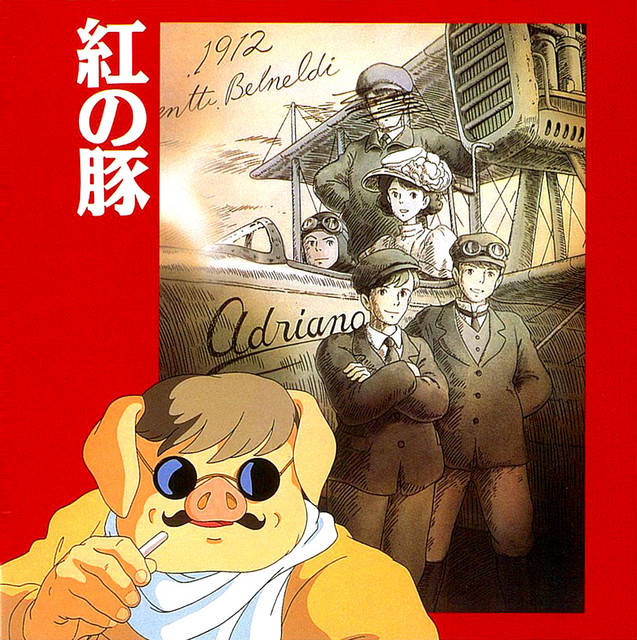
Album: 紅の豚 イメージアルバム
In the world of animated film music, few composers have mastered the art of thematic development quite like Joe Hisaishi. His approach to the Porco Rosso image album ‘紅の豚 イメージアルバム’ reveals a fascinating creative process that blurs the lines between personal artistic vision and collaborative filmmaking, resulting in one of his most jazz-influenced works.
The story behind this 1992 image album begins not with Hayao Miyazaki’s vision of sky pirates over the Adriatic Sea, but with an extraordinary coincidence of artistic timing. While Miyazaki was developing his tale of the mysterious pig pilot set in 1930s Italy, Hisaishi was simultaneously working on his solo album ‘My Lost City’, inspired by F. Scott Fitzgerald’s literature and focused on the 1920s jazz age. When the composer realized both projects shared similar historical periods, he felt what he later described as ‘something very fateful about living in the same era as an artist.’
This serendipitous alignment would prove crucial to the image album’s development. The ten tracks that comprise this collection serve as more than mere background music; they function as character studies and atmospheric paintings that capture the romantic melancholy of interwar Europe. Unlike many image albums that exist purely as promotional material, Hisaishi’s Porco Rosso collection became a creative laboratory where themes would evolve and mature before finding their final form in the actual film.
Take ‘Marco to Gina no Theme’ (Marco and Gina’s Theme), the album’s closing track. This piece represents the emotional core of the entire project, serving as the prototype for what would eventually become ‘Kaeranu Hibi’ (Days of Returning) in the final film. The original version captures the bittersweet relationship between the cursed pilot and the hotel owner who represents his lost humanity. Hisaishi’s jazz background, rooted in his student years listening to Miles Davis, John Coltrane, and particularly Mal Waldron, infuses the melody with a sophisticated harmonic language that elevates it beyond typical film scoring. The influence of Waldron’s piano approach is particularly evident here, where space and silence carry as much emotional weight as the notes themselves.
‘Piccolo-sha’ (The Piccolo Company) offers another fascinating glimpse into Hisaishi’s developmental process. This track would eventually transform into ‘Piccolo no Onnatachi’ (The Women of Piccolo) in the finished film, but its image album incarnation reveals different priorities. Here, Hisaishi focuses less on the specific narrative function and more on capturing the spirit of Italian craftsmanship and feminine solidarity that defines Fio Piccolo’s family workshop. The composer’s orchestral sensibilities, honed through years of minimalist composition, blend seamlessly with jazz-influenced chord progressions to create something uniquely his own.
Perhaps the most telling example of this creative cross-pollination appears in ‘Dabohaze’, which would become ‘Flying Boatmen’ in the final score. The track’s title refers to a type of aggressive fish, metaphorically representing the sky pirates who terrorize the Adriatic. But rather than creating obvious ‘villain music’, Hisaishi approaches these characters with the same romantic lens he applies to his heroes. This reflects his broader philosophy that music should serve the emotional truth of a story rather than simply underscore plot points.
The integration of material from ‘My Lost City’ into the Porco Rosso project represents one of the most successful examples of cross-pollination in film music history. When Miyazaki heard Hisaishi’s completed solo album, his response was immediate and enthusiastic: he wanted ‘all of those songs’ for his film. This wasn’t merely directorial enthusiasm; it represented recognition that Hisaishi had captured something essential about the period that transcended the boundaries between concert music and film scoring.
The influence proved mutual. Tracks like ‘1920~Age of Illusion’ from ‘My Lost City’ directly inspired the opening sequence of Porco Rosso, while ‘Kyoki’ (Madness) was incorporated wholesale into the film’s canal takeoff scene. This creative exchange demonstrates Hisaishi’s belief that the artificial boundaries between ‘serious’ composition and film music serve neither art form well.
Hisaishi’s jazz influences extend beyond harmonic vocabulary into his approach to musical storytelling. Like the great jazz pianists he admired, he understands that the most powerful musical moments often emerge from restraint rather than bombast. This philosophy permeates the image album, where orchestral arrangements breathe with the spaciousness of a jazz ballad rather than the wall-to-wall density typical of adventure scoring.
The album’s success lies partly in its refusal to simply serve as a musical preview of coming attractions. Instead, these ten tracks function as an independent artistic statement that happens to share DNA with a beloved animated film. ‘Adriatic Sea’s Blue Sky’ opens the collection not with fanfare but with contemplative beauty, establishing an emotional landscape rather than promising action sequences.
This approach reflects Hisaishi’s broader understanding of his role as a collaborator rather than a service provider. His relationship with Miyazaki has always been characterized by mutual respect for each other’s artistic vision, and the Porco Rosso project represents this partnership at its most symbiotic. The image album reveals how deeply the composer had internalized the story’s themes of loss, redemption, and the persistence of beauty in a broken world.
The lasting influence of this approach can be heard throughout Hisaishi’s subsequent work, where jazz harmonies and spacious arrangements became increasingly prominent. But more importantly, the Porco Rosso image album established a creative methodology that treats preliminary musical sketches as worthy of artistic consideration in their own right.
Listening to these tracks today, one hears not just the seeds of a beloved film score, but a complete artistic statement that captures the melancholy romance of a vanished era. Hisaishi’s ability to channel his jazz influences through his classical training while serving a narrative purpose creates music that works equally well in concert halls and home listening environments.
The Porco Rosso image album stands as proof that the best film music emerges not from calculated commercial considerations, but from the intersection of personal artistic vision with collaborative opportunity. In Hisaishi’s hands, an image album became something far more valuable: a document of creative process and artistic growth that continues to reward careful listening three decades after its creation.
- アドリア海の青い空Read Review
- 冒険飛行家の時代Read Review
- 真紅の翼Read Review
- 雲海のサボイアRead Review
- ピッコロ社Read Review
- 戦争ゴッコRead Review
- ダボハゼRead Review
- アドリアーノの窓Read Review
- 世界恐慌Read Review
- マルコとジーナのテーマRead Review
Sources
- Porco Rosso Soundtrack LP Liner Notes (2020)
- I Am: The Way of Music / Porco Rosso Soundtrack Liner Notes
- I Am: The Way of Music (Joe Hisaishi)