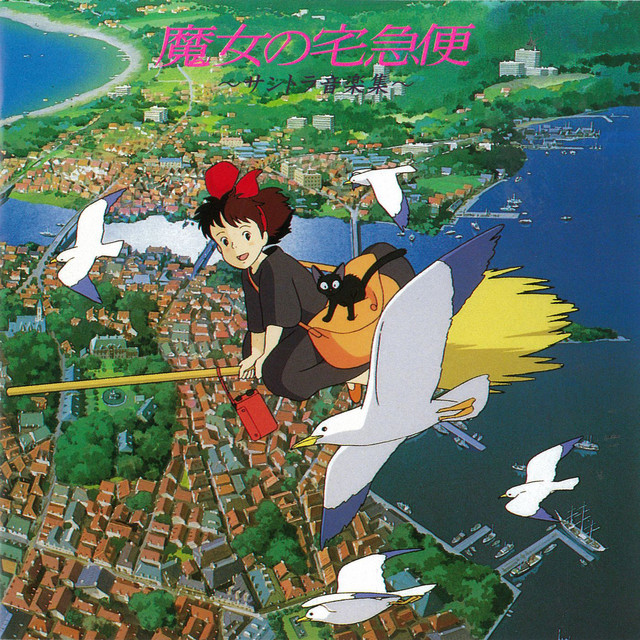
Album: 魔女の宅急便 サントラ音楽集
Behind every beloved Studio Ghibli soundtrack lies a story of artistic vision meeting impossible deadlines. Joe Hisaishi’s “Ōisogashi no Kiki” (Kiki’s Busy Day) from the Kiki’s Delivery Service soundtrack represents perhaps one of the most remarkable examples of creative pressure producing musical magic.
The summer of 1989 was shaping up to be a nightmare for Hisaishi. Fresh off a New York recording session, the composer found himself in a time crunch that would make most musicians break into cold sweats. With only one month until the film’s nationwide release on July 29th, he had to complete additional compositions and arrangements for what would become one of anime’s most cherished soundtracks.
The day after returning from New York, Hisaishi was already in meetings. Two days later, he was in the recording studio. This wasn’t just tight scheduling – it was musical acrobatics without a safety net. Yet from this chaos emerged “Kiki’s Busy Day,” a track that perfectly captures the frenetic energy of a young witch learning to navigate both flight and responsibility.
What makes this piece particularly fascinating is how it embodies Hisaishi’s deliberate shift away from synthesized sounds toward organic instrumentation. “This time I drastically reduced the use of synthesizers,” Hisaishi explained. “Since the content was more realistic, I brought everything closer to live sound overall.” This philosophy permeates every measure of “Kiki’s Busy Day,” where acoustic instruments dance together in a Mediterranean-influenced waltz that breathes with authentic warmth.
The three-quarter time signature that drives the track wasn’t chosen arbitrarily. Hisaishi had committed to incorporating European folk dance elements throughout the score, drawing inspiration from Mediterranean melodies and traditional dance forms. The dulcimer – a hammered string instrument that predates the modern piano – adds an authentically European texture that synthesizers simply couldn’t replicate. Alongside guitars and accordions, these instruments create a sonic landscape that feels both exotic and familiar.
But perhaps the most ingenious aspect of “Kiki’s Busy Day” lies in its extensive use of wind instruments. Woodwinds, accordion, and even subtle ocarina touches populate the arrangement, each breath-driven sound serving a deeper symbolic purpose. These instruments don’t just provide melody and harmony – they represent the very essence of wind itself, the invisible force that carries Kiki through the sky and through life.
This connection between breath and flight reveals Hisaishi’s sophisticated understanding of musical storytelling. Every exhale from a flute or squeeze of an accordion bellows mirrors Kiki’s own breathing as she soars above the fictional European city of Koriko. The wind instruments become her life force made audible, her determination given musical form. When the music grows busier and more complex – as it does in this particular track – we’re hearing Kiki’s growing confidence and increasing responsibilities played out in real time.
The recording process itself reflected the energy of the piece. With a full orchestra assembled in early July, Hisaishi conducted sessions that captured both precision and spontaneity. The musicians, aware they were working against an impossible deadline, brought an urgency to their performances that you can hear in the final recordings. There’s a slight edge to the playing, a forward momentum that pushes each phrase into the next with barely contained excitement.
This approach stood in stark contrast to the film’s other musical elements. While Hisaishi was crafting his breathless orchestral pieces, the directors had chosen Yumi Matsutoya’s contemporary pop songs for specific scenes, including “Yasashisa ni Tsutsumareta Nara” (Surrounded by Tenderness). The juxtaposition was intentional – urban sophistication represented by radio-friendly pop, rural magic embodied by Hisaishi’s acoustic orchestrations.
“Kiki’s Busy Day” sits perfectly within this musical ecosystem. Its folk-dance foundation keeps it grounded in European tradition, while its bustling pace and intricate arrangements reflect the modern world Kiki must navigate. The piece serves as a sonic bridge between old and new, between the magical and the mundane.
Listening to the track today, it’s remarkable to consider that such a polished, emotionally resonant piece emerged from what was essentially a controlled panic. The music doesn’t sound rushed or compromised – it sounds alive, breathing with the same vitality as the wind instruments that define its character.
This is the magic of deadline-driven creativity: sometimes impossible schedules force artists to trust their instincts completely. Hisaishi couldn’t second-guess his choices or endlessly refine his arrangements. He had to compose, orchestrate, and record with the same fearless energy that Kiki brings to her first solo flights. The result is music that captures not just the story on screen, but the very real drama happening behind the scenes – a young witch learning to fly, and a master composer learning to trust the wind beneath his own creative wings.
- 晴れた日に…Read Review
- 旅立ち
- 海の見える街Read Review
- 空とぶ宅急便Read Review
- パン屋の手伝いRead Review
- 仕事はじめRead Review
- 身代わりジジRead Review
- ジェフRead Review
- 大忙しのキキNow Playing
- パーティーに間に合わないRead Review
- オソノさんのたのみ事…Read Review
- プロペラ自転車Read Review
- とべない!Read Review
- 傷心のキキRead Review
- ウルスラの小屋へRead Review
- 神秘なる絵Read Review
- 暴飛行の自由の冒険号Read Review
- おじいさんのデッキブラシRead Review
- デッキブラシでランデブーRead Review