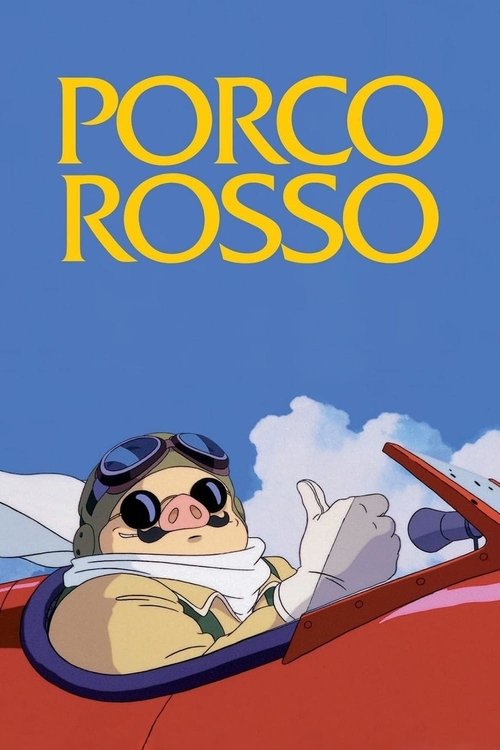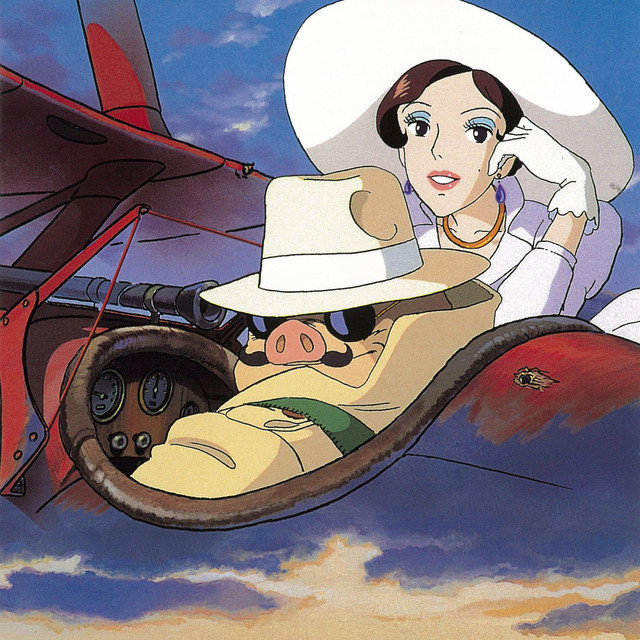
Album: 紅の豚 サウンドトラック
What happens when a composer must translate the heartbreak of a pilot lost to the clouds into music? For Joe Hisaishi, crafting ‘Lost Spirit’ for Porco Rosso’s soundtrack meant venturing into uncharted territory where jazz-age nostalgia meets ethereal synthesizer work. The result is a haunting piece that exemplifies how film music had evolved beyond mere accompaniment into deeply personal artistic expression.
The genesis of Hisaishi’s approach to Porco Rosso began with poetry. Director Hayao Miyazaki handed him six poems as creative roadmaps: ‘Seaplane Pilot’s Tango,’ ‘Ascension,’ ‘Adriatic Sea at Twilight,’ ‘Night Flight,’ ‘Secret Garden,’ and ‘Merry-Go-Round.’ These weren’t casual suggestions but primary source material designed to share the film’s emotional landscape. ‘Lost Spirit’ emerged from this collaborative foundation, specifically addressing the tragic backstory of Gina’s first husband, Bellini, whose disappearance into the clouds becomes a recurring motif throughout the film.
The choice to employ Fairlight synthesizers for this particular piece was no accident. The Fairlight CMI, with its ethereal, almost ghostly timbre, became Hisaishi’s tool for depicting the supernatural quality of Bellini’s vanishing. The synthesizer’s ability to create sounds that seem to float between reality and dream made it perfect for capturing a soul literally lost to the sky. This wasn’t merely about creating ambient background music; it was about manifesting the intangible grief of loss through electronic sound.
Yet ‘Lost Spirit’ exists within a broader musical context that reflects Hisaishi’s evolving relationship with film scoring. By the early 1990s, he had reached a pivotal moment where the boundaries between his film work and solo albums began dissolving. The Porco Rosso soundtrack became an extension of his personal album ‘My Lost City,’ allowing him to infuse the score with authorial voice rather than simply serving the narrative.
This shift was crucial for understanding why ‘Lost Spirit’ feels so personal despite being written for a specific cinematic moment. Hisaishi was no longer just a composer-for-hire but an artistic collaborator bringing his own emotional vocabulary to the project. The piece reflects this newfound freedom, moving beyond conventional film scoring into something more akin to ambient composition with narrative purpose.
The jazz elements that permeate the Porco Rosso soundtrack also inform ‘Lost Spirit,’ though more subtly. Set in the 1920s Jazz Age, the film’s musical palette naturally gravitated toward period-appropriate instrumentation. While ‘Lost Spirit’ doesn’t feature the overt jazz piano that characterizes other tracks, it exists in dialogue with them. The contrast between the earthy, grounded jazz of the tavern scenes and the otherworldly synthesizers of the lost soul sequence creates emotional depth through musical juxtaposition.
Hisaishi’s decision to anchor the main themes in jazz piano wasn’t purely aesthetic but rooted in historical authenticity. The 1920s marked jazz’s cultural zenith, making it the logical musical language for Marco and Gina’s relationship. When ‘Lost Spirit’ appears, its electronic palette serves as a sonic bridge between the tangible world of jazz-age Europe and the mystical realm where lost pilots dwell.
This duality—earthbound jazz versus ethereal electronics—represents one of two major innovations that distinguished Porco Rosso’s score from Hisaishi’s previous Studio Ghibli work. The integration of existing solo material alongside jazz elements created what critics have identified as the musical foundation that elevated the film beyond simple aviation adventure into profound meditation on loss, memory, and the spaces between life and death.
‘Lost Spirit’ specifically demonstrates Hisaishi’s mastery of emotional architecture through sound. The piece typically unfolds in D minor, a key traditionally associated with melancholy and introspection. Its slow tempo and sustained synthesizer textures create what musicologists call ‘temporal suspension’—time seems to stop, mirroring the eternal moment of Bellini’s disappearance.
The Fairlight’s sampling capabilities allowed Hisaishi to manipulate acoustic sounds into something beyond recognition while retaining organic qualities. This technology enabled him to create sounds that feel both familiar and alien, perfectly suited to depicting a soul caught between worlds. The resulting texture speaks to universal experiences of loss while remaining specifically tied to the film’s narrative.
More broadly, ‘Lost Spirit’ represents Hisaishi’s evolution from functional film composer to cinematic poet. The piece works both within Porco Rosso’s narrative framework and as standalone ambient composition, demonstrating how film music had begun embracing the same artistic ambitions as concert hall works.
This transformation reflects broader changes in film music during the early 1990s, when composers increasingly viewed soundtracks as legitimate artistic statements rather than mere commercial assignments. Hisaishi’s willingness to bring his full creative personality to Miyazaki’s vision resulted in music that enhances the film while maintaining its own artistic integrity.
‘Lost Spirit’ ultimately succeeds because it trusts listeners to engage with abstract emotion through sound alone. Rather than telegraphing grief through obvious musical gestures, Hisaishi creates an atmospheric space where loss becomes palpable without being literal. In doing so, he transforms a specific narrative moment into universal meditation on impermanence, making the Fairlight synthesizer sing with the voice of memory itself.
- 時代の風-人が人でいられた時-Read Review
- MAMMAIUTORead Review
- Addio!Read Review
- 帰らざる日々Read Review
- セピア色の写真Read Review
- セリビア行進曲Read Review
- Flying boatmenRead Review
- Doom-雲の罠-Read Review
- Porco e BellaRead Review
- Fio-SeventeenRead Review
- ピッコロの女たちRead Review
- FriendRead Review
- Partner shipRead Review
- アドリアの海へRead Review
- 遠き時代を求めてRead Review
- 荒野の一目惚れRead Review
- 夏の終わりにRead Review
- 失われた魂-LOST SPIRIT-Now Playing
- Dog fightRead Review
- Porco e Bella-Ending-Read Review