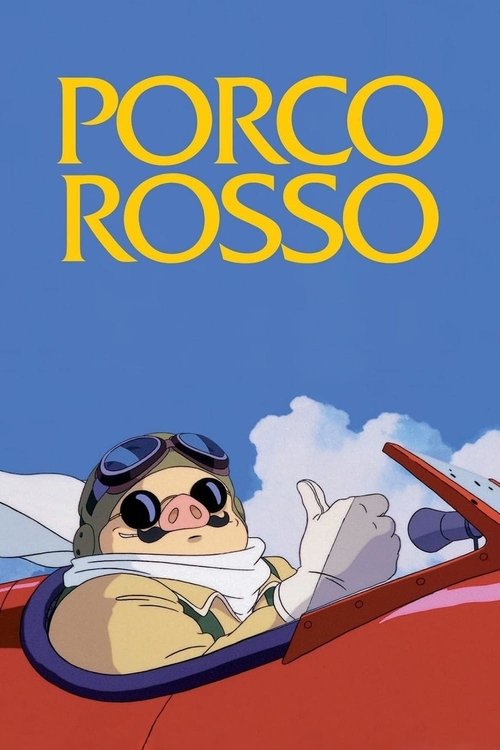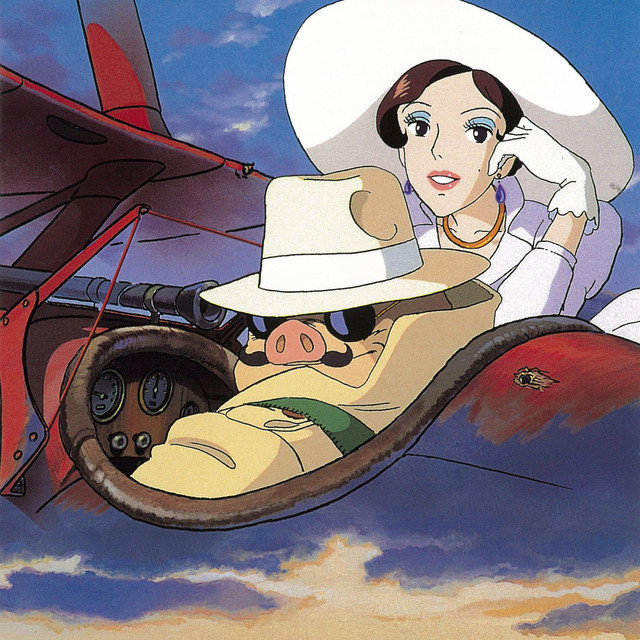
Album: 紅の豚 サウンドトラック
Sometimes the universe conspires to create something extraordinary. In the early 1990s, two creative minds were unknowingly walking parallel paths that would intersect to produce one of Studio Ghibli’s most musically sophisticated soundtracks. While Hayao Miyazaki was conceptualizing a story about a cursed pig pilot in 1920s Italy, Joe Hisaishi was deep in the throes of creating his solo album ‘My Lost City’, inspired by F. Scott Fitzgerald’s Jazz Age literature.
‘Serbia March’ (Serebia Kōshinkyoku) from the Porco Rosso soundtrack exemplifies this serendipitous collision of artistic vision. The piece emerges from the film’s pivotal tavern scene, where Gina’s piano fills the smoky air with melancholic jazz—a perfect musical embodiment of the era’s bittersweet romance and lost innocence.
The march unfolds in B-flat major with a moderate swing tempo, its melody carried by solo piano before being joined by muted brass and subtle percussion. Hisaishi’s arrangement deliberately evokes the intimate setting of a 1920s speakeasy, where every note carries the weight of unspoken longing between Marco and Gina. The composition’s harmonic language borrows heavily from period-appropriate jazz progressions, yet maintains Hisaishi’s signature melodic sensibility that makes it unmistakably his own.
What makes this musical moment so compelling is the extraordinary backstory of its creation. When Hisaishi completed ‘My Lost City’—his personal exploration of 1920s America through a Japanese composer’s lens—he sent a copy to Miyazaki as a courtesy. The director’s response was immediate and emphatic: “I want all of those songs, every single one for Porco Rosso.” This wasn’t mere enthusiasm; it was recognition of a shared artistic wavelength that transcended their individual projects.
“I felt something deeply fateful about it,” Hisaishi later reflected on this moment. “Here we were, two artists living in the same era, independently drawn to the same historical period.” This cosmic alignment would fundamentally reshape how the Porco Rosso soundtrack was conceived and executed.
The inclusion of jazz elements wasn’t merely decorative—it was historically essential. The 1920s represented the golden age of jazz, when the genre’s influence permeated every aspect of cultural life from New York to Milan. For characters like Marco and Gina, jazz would have been the soundtrack of their youth, the music of their romantic awakening, and ultimately, the sound of their disillusionment. Hisaishi understood this implicitly, drawing from his deep appreciation for jazz masters like Miles Davis, John Coltrane, and particularly Mal Waldron, whose piano style profoundly influenced his approach to the instrument.
While many know Hisaishi primarily as an orchestral composer and minimalist pioneer, his jazz credentials run surprisingly deep. His student years were spent immersed in the works of these legends, and Waldron’s introspective piano approach can be heard echoing through pieces like ‘Serbia March.’ The composition’s contemplative passages and subtle harmonic sophistication reveal a composer equally at home with jazz’s improvisational spirit and classical music’s structural discipline.
The fusion of these influences—Hisaishi’s personal jazz exploration through ‘My Lost City’ and the narrative demands of Miyazaki’s period aviation drama—created something unprecedented in the Ghibli canon. Previous collaborations between the two had relied heavily on orchestral grandeur and folk-influenced melodies. Porco Rosso introduced a more intimate, adult musical language that matched its themes of middle-aged regret and romantic complexity.
‘Serbia March’ specifically captures this maturity through its restraint. Unlike the soaring themes of earlier Ghibli films, this piece operates in the shadows, its emotions filtered through the haze of cigarette smoke and amber lighting. The march rhythm suggests forward momentum, yet the harmonic progressions circle back on themselves, creating a sense of beautiful entrapment that mirrors Marco’s emotional state.
This musical approach elevated Porco Rosso beyond a simple aviation adventure into something more psychologically complex. The jazz elements provided an authentic period atmosphere while serving the story’s deeper themes about lost love, personal transformation, and the weight of the past. When Gina plays piano in her empty tavern, she’s not just providing background music—she’s channeling the collective memory of an entire generation shaped by war and longing.
The success of this approach validated Hisaishi’s belief that film music should serve multiple masters: historical authenticity, narrative support, and pure musical expression. ‘Serbia March’ accomplishes all three, creating a piece that works equally well as period atmosphere, character development, and standalone musical statement.
Looking back, the convergence of Hisaishi’s jazz explorations with Miyazaki’s storytelling needs seems less like coincidence and more like artistic destiny. Sometimes the best collaborations emerge not from careful planning, but from the mysterious alignment of creative souls pursuing their separate visions along surprisingly parallel paths.
- 時代の風-人が人でいられた時-Read Review
- MAMMAIUTORead Review
- Addio!Read Review
- 帰らざる日々Read Review
- セピア色の写真Read Review
- セリビア行進曲Now Playing
- Flying boatmenRead Review
- Doom-雲の罠-Read Review
- Porco e BellaRead Review
- Fio-SeventeenRead Review
- ピッコロの女たちRead Review
- FriendRead Review
- Partner shipRead Review
- アドリアの海へRead Review
- 遠き時代を求めてRead Review
- 荒野の一目惚れRead Review
- 夏の終わりにRead Review
- 失われた魂-LOST SPIRIT-Read Review
- Dog fightRead Review
- Porco e Bella-Ending-Read Review