
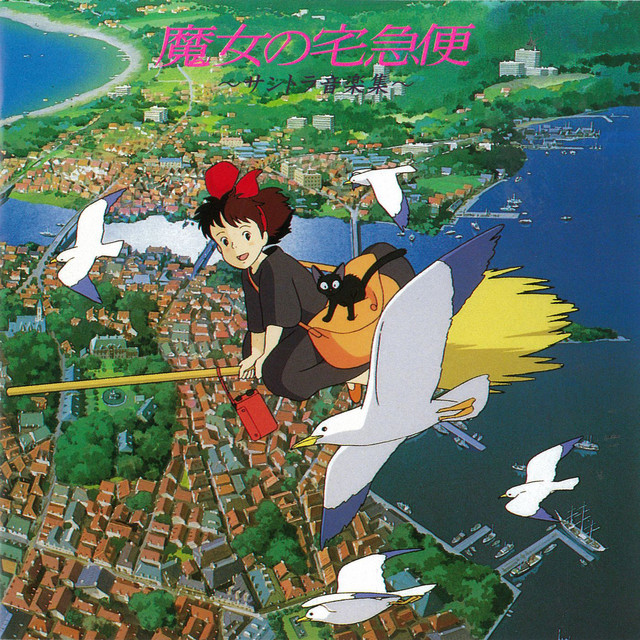
Album: 魔女の宅急便 サントラ音楽集
When Joe Hisaishi stepped off the plane from New York in June 1989, he had exactly one month to capture the essence of a young witch’s coming-of-age story in music. The composer faced an impossible deadline: create an entire orchestral score for Hayao Miyazaki’s ‘Kiki’s Delivery Service’ in time for the film’s July 29th release. What emerged from this pressure-cooker situation was one of Studio Ghibli’s most distinctive soundtracks, a musical tapestry that would transport audiences to the fictional European town of Corico through the power of authentic folk instrumentation and dance rhythms.
Hisaishi’s approach to scoring ‘Kiki’s Delivery Service’ marked a deliberate departure from his earlier synthesizer-heavy work. The composer consciously reduced electronic elements in favor of organic, acoustic sounds that would mirror the film’s realistic portrayal of a young woman finding her place in the world. This shift toward ‘living’ instruments wasn’t merely aesthetic—it reflected the story’s fundamental humanity.
The European setting demanded musical authenticity that went beyond surface-level orchestration. Hisaishi immersed himself in the continent’s folk traditions, incorporating instruments like the dulcimer (a precursor to the piano), guitar, and accordion to evoke the Mediterranean atmosphere Miyazaki envisioned. The result was a score that breathed with the same coastal air that fills Corico’s streets.
Perhaps no track better embodies this European sensibility than ‘Umi no Mieru Machi’ (The Town with an Ocean View). Here, Hisaishi employs the three-quarter time signature that permeates much of the album, creating a waltz-like quality that feels both nostalgic and forward-looking. The melody carries hints of Greek folk music while maintaining the composer’s signature emotional directness. It’s music that doesn’t just accompany Kiki’s first glimpse of her new home—it captures the mixture of excitement and uncertainty that defines any major life transition.
The composer’s philosophy for Miyazaki’s films centered on creating music that could be sung with full voice, avoiding overly sophisticated or precious arrangements in favor of straight-from-the-heart melodies. This approach shines through in ‘Tabidachi’ (Departure), which opens the album with a sense of anticipation and possibility. The track builds gradually, incorporating wind instruments that serve multiple symbolic purposes throughout the score.
Hisaishi’s extensive use of breath-powered instruments—ocarinas, accordions, and woodwinds—wasn’t coincidental. These instruments embody the very element that allows Kiki to fly: wind. More than mere accompaniment to her aerial deliveries, these sounds represent the life force that drives the young witch forward. When she loses her ability to fly, it’s telling that the music becomes more grounded, relying less on these airy textures.
The scoring sessions themselves became legendary within the industry for their breakneck pace. After Hisaishi’s return from his New York recording obligations, the composer had to complete additional compositions and arrangements in a matter of days. The full orchestra recording in early July required split-second precision, with no time for extensive revisions or second-guessing. This time pressure, rather than hindering creativity, seemed to focus Hisaishi’s musical instincts.
‘Tobenai!’ (I Can’t Fly!) demonstrates how the composer translated Kiki’s internal struggles into musical language. The track abandons the buoyant rhythms found elsewhere on the album, instead presenting fragmented melodies that mirror the protagonist’s fractured confidence. The absence of prominent wind instruments in key passages reinforces the connection between breath, flight, and self-assurance that runs throughout the score.
The album’s dance-like qualities extend beyond mere rhythmic patterns into deeper cultural territory. European folk dances traditionally served as community gatherings, spaces where individuals found their place within larger social structures. Kiki’s story follows a similar trajectory, as she learns to integrate her magical abilities with the practical needs of Corico’s residents. The music reflects this integration through its blend of mystical and earthbound elements.
Hisaishi’s commitment to emotional honesty over technical complexity proved prescient. While many animated film scores from the late 1980s now sound dated, the ‘Kiki’s Delivery Service’ soundtrack maintains its immediacy. The composer’s decision to ground fantastical elements in recognizable musical traditions created a work that feels both magical and believable.
The recording process, compressed into just weeks, forced Hisaishi to trust his initial instincts rather than overthinking arrangements. This urgency paradoxically produced some of his most natural-sounding work. The orchestra captured performances that retained the spontaneity of folk music while achieving the polish necessary for cinematic presentation.
Looking at the complete track listing, the arc of Kiki’s journey becomes apparent through Hisaishi’s musical storytelling. From the hopeful departure through struggles with self-doubt to final triumph, each piece serves both standalone listening and narrative function. The composer understood that audiences would encounter these melodies both within the film’s context and as independent musical experiences.
The influence of this approach extended far beyond a single soundtrack. Hisaishi’s integration of authentic folk elements with orchestral sophistication helped establish a template for how animated films could engage with cultural specificity without sacrificing universal appeal. The music works because it doesn’t try to explain Kiki’s world—it inhabits it.
Nearly three decades after its release, the ‘Kiki’s Delivery Service’ soundtrack continues to attract listeners who may never have seen Miyazaki’s film. The music’s ability to evoke a sense of European charm while addressing universal themes of growth and belonging speaks to Hisaishi’s skill at finding the human element within fantastical premises. In a month of impossible deadlines and creative pressure, the composer created a work that captures both the specific magic of a young witch’s adventure and the broader magic of finding one’s place in the world.
- 晴れた日に…Read Review
- 旅立ち
- 海の見える街Read Review
- 空とぶ宅急便Read Review
- パン屋の手伝いRead Review
- 仕事はじめRead Review
- 身代わりジジRead Review
- ジェフRead Review
- 大忙しのキキRead Review
- パーティーに間に合わないRead Review
- オソノさんのたのみ事…Read Review
- プロペラ自転車Read Review
- とべない!Read Review
- 傷心のキキRead Review
- ウルスラの小屋へRead Review
- 神秘なる絵Read Review
- 暴飛行の自由の冒険号Read Review
- おじいさんのデッキブラシRead Review
- デッキブラシでランデブーRead Review

Sources
- Kiki’s Delivery Service Roman Album
- Kiki’s Delivery Service Soundtrack LP Liner Notes (2020)