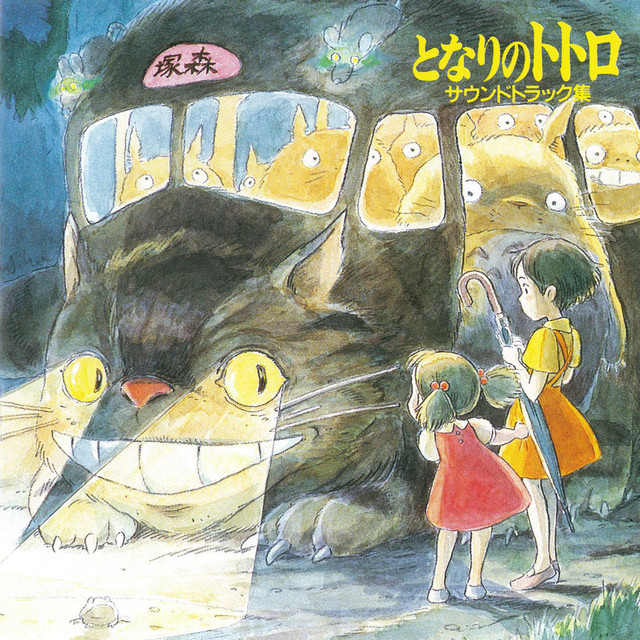
Album: となりのトトロ サウンドトラック集
When Joe Hisaishi sat down to compose the soundtrack for My Neighbor Totoro, he faced a creative dilemma that would define not just this film, but an entire generation’s relationship with animated music. How do you score a story about childhood wonder without falling into the trap of creating ‘just another children’s movie’? His solution, exemplified beautifully in tracks like ‘Moonlight Flight’ (Tsukiyo no Hikou), reveals a composer willing to challenge conventional wisdom about what family films should sound like.
Hisaishi’s approach to the Totoro soundtrack represents a fascinating collision between Eastern and Western musical traditions. Rather than relying solely on traditional orchestral arrangements, he deliberately wove ethnic elements throughout the score, creating what he described as a careful balance between ‘ethnic and ordinary orchestral music.’ This wasn’t a random artistic choice—it was a philosophical statement about the nature of childhood itself.
‘Moonlight Flight,’ one of the more ethereal pieces from the soundtrack, demonstrates this fusion perfectly. The track opens with delicate orchestral strings, but it’s the underlying percussion that gives the piece its distinctive character. Hisaishi didn’t simply hire session musicians to provide these exotic sounds; he took matters into his own hands, literally. The tabla rhythms that pulse beneath the melody were performed by the composer himself, sampled and integrated into the final mix. This hands-on approach speaks to Hisaishi’s commitment to authenticity—he wasn’t appropriating sounds from another culture, but rather learning and respecting the instruments enough to play them himself.
The decision to incorporate ethnic percussion wasn’t born from a desire to be different for its own sake. Hisaishi explained that using ‘ordinary orchestra alone would result in a very common children’s movie.’ He recognized that Totoro’s story, with its emphasis on daily life and small magical moments, needed something more nuanced than traditional film scoring could provide. The minimalist, slightly ethnic atmosphere he created through tracks like ‘Moonlight Flight’ elevated the material beyond simple children’s entertainment.
This musical philosophy extended to the structural approach of the entire soundtrack. While songs like ‘Sanpo’ (the opening theme) and ‘My Neighbor Totoro’ served as the main musical themes, Hisaishi developed what he called ‘hidden themes’—subtle musical motifs that would support specific narrative moments. ‘The Path of the Wind’ became one such hidden theme, deployed during scenes featuring the camphor tree. ‘Moonlight Flight’ functions similarly, providing emotional support for moments of wonder without overwhelming the visual storytelling.
The challenge Hisaishi faced with Totoro was unprecedented in his career. Unlike his previous work on Nausicaä, which had clear dramatic peaks and valleys, Totoro consisted primarily of everyday sequences. How do you score the mundane without making it boring? How do you enhance wonder without becoming saccharine? His solution was to step back from the aggressive musical storytelling that dominated most film scores of the era.
‘I felt that strong music would seem detached from the screen,’ Hisaishi reflected on his restrained approach. This restraint is evident in ‘Moonlight Flight,’ which unfolds in B major at a gentle andante tempo, allowing space for the audience’s imagination to fill in emotional gaps. The track never pushes too hard, never demands attention, but instead creates an atmospheric foundation that supports the film’s contemplative moments.
The risk of this approach was significant. Hisaishi acknowledged that ‘one step in the wrong direction could result in the world of nursery rhymes.’ Walking this tightrope required incredible sensitivity to both musical tradition and narrative function. Too little musical presence, and the film would feel empty; too much, and it would overshadow Miyazaki’s carefully crafted visual poetry.
This balancing act extended to Hisaishi’s initial work on the project. He originally created an image album—essentially a collection of songs rather than instrumental pieces—because he believed that vocal music would better capture the essence of the film’s everyday scenes. The instrumental tracks like ‘Moonlight Flight’ came later, as he refined his understanding of how music could serve the story without dominating it.
The success of this approach has influenced film composition far beyond Studio Ghibli. Hisaishi’s integration of ethnic percussion, minimalist structures, and restrained orchestration created a new template for how to score intimate, character-driven animation. ‘Moonlight Flight’ stands as a perfect example of this philosophy in action—a piece that sounds simple on the surface but reveals layers of cultural fusion and compositional sophistication upon closer listening.
Today, when film composers face similar challenges in scoring family entertainment, many return to the principles Hisaishi established with Totoro. The idea that children’s music can be both accessible and artistically ambitious, that ethnic instruments can enhance rather than exoticize, and that restraint can be more powerful than bombast—these concepts continue to influence how we think about music’s role in visual storytelling.
- さんぽ-オープニング主題歌-Read Review
- 五月の村Read Review
- オバケやしき!Read Review
- メイとすすわたりRead Review
- 夕暮れの風Read Review
- こわくないRead Review
- おみまいにいこうRead Review
- おかあさんRead Review
- 小さなオバケRead Review
- トトロRead Review
- 塚森の大樹Read Review
- まいごRead Review
- 風のとおり道(インストゥルメンタンル)Read Review
- ずぶぬれオバケRead Review
- 月夜の飛行Now Playing
- メイがいないRead Review
- ねこバスRead Review
- よかったねRead Review
- となりのトトロ-エンディング主題歌-Read Review
- さんぽ(合唱つき)Read Review