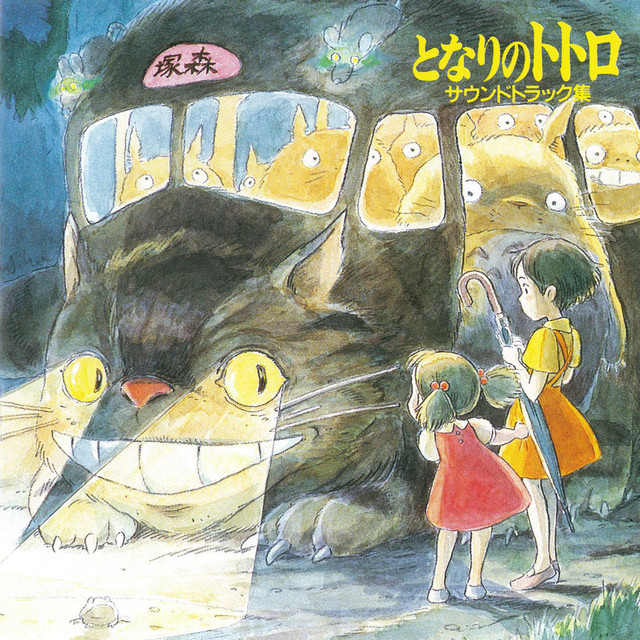
Album: となりのトトロ サウンドトラック集
Picture this: you’re sitting in a recording studio in 1988, tasked with creating music for a film about magical forest creatures and two young sisters. The challenge? How do you craft a soundtrack that captures both the everyday mundane and the fantastical without falling into the trap of creating ‘just another children’s movie’? This was precisely the dilemma Joe Hisaishi faced when composing the My Neighbor Totoro soundtrack, and ‘Gogatsu no Mura’ (Village of May) serves as a perfect example of his ingenious solution.
Hisaishi’s approach to the Totoro soundtrack reveals a composer grappling with fundamental questions about musical identity and audience perception. ‘If I wrote purely orchestral pieces,’ he reflected, ‘it would become an ordinary children’s film.’ This concern drove him toward an innovative hybrid approach that would define not just this album, but his entire collaboration with Studio Ghibli. The composer understood that conventional Western orchestration alone would diminish the unique atmosphere Miyazaki was creating on screen.
‘Village of May’ exemplifies Hisaishi’s solution: a careful fusion of ethnic instrumentation with traditional orchestral arrangements. The piece opens with gentle woodwinds in a pastoral D major, immediately establishing the rural Japanese setting. But listen closer, and you’ll hear the subtle integration of non-Western percussion elements that give the track its distinctive character. What makes this particularly fascinating is that Hisaishi didn’t simply hire session musicians for these ethnic elements – he performed the tabla parts himself, sampling his own percussion work to ensure the integration felt organic rather than tokenistic.
This hands-on approach reflects Hisaishi’s deeper musical philosophy. Rather than viewing Eastern and Western musical traditions as separate entities to be combined, he treats them as complementary languages within a single conversation. In ‘Village of May,’ the ethnic elements don’t announce themselves dramatically; instead, they weave through the orchestral fabric like sunlight filtering through forest leaves. The result is what Hisaishi calls ‘minimal music with an ethnic atmosphere’ – a sound that feels both familiar and mysteriously otherworldly.
The creative process behind this track also illuminates Hisaishi’s collaborative relationship with Miyazaki. The director’s film presented unique challenges: abundant daily life sequences with relatively weak dramatic tension. Traditional film scoring wisdom might suggest using strong, emotionally directive music to compensate. Hisaishi chose the opposite path. ‘Strong music would feel disconnected from the screen,’ he reasoned, opting instead for what he termed ‘non-assertive’ compositions that supported rather than dominated the visual narrative.
This philosophy transforms ‘Village of May’ from mere background music into something more sophisticated – environmental storytelling through sound. The piece breathes with the rhythm of rural Japanese life, its gentle tempo matching the unhurried pace of childhood summers. The instrumentation choices reflect this environmental approach: flutes evoke morning mist over rice fields, while string sections provide the warm embrace of community and family.
Hisaishi’s structural thinking becomes even more apparent when considering the album’s overall architecture. He describes maintaining consistency since Nausicaä in balancing ethnic and orchestral elements, but Totoro demanded more nuanced execution. The soundtrack features main themes like ‘Sanpo’ (A Walk) and the title track ‘My Neighbor Totoro,’ supported by what Hisaishi called ‘shadow themes’ like ‘Kaze no Toorimichi’ (The Path of Wind). ‘Village of May’ functions within this ecosystem, providing textural contrast while maintaining thematic coherence.
What emerges from studying pieces like ‘Village of May’ is a portrait of a composer who understands that restraint often proves more powerful than spectacle. Hisaishi walked a tightrope between童謡 (children’s songs) simplicity and sophisticated musical storytelling. Too simple, and the music becomes patronizing; too complex, and it overwhelms Miyazaki’s delicate visual poetry.
The lasting impact of this approach extends far beyond a single track or even a single film. ‘Village of May’ represents a turning point in film music, demonstrating how composers can honor multiple cultural traditions without creating awkward fusion. Hisaishi’s method – deep personal involvement in every musical element, careful attention to narrative function, and respect for the audience’s intelligence – established a template that continues influencing film composers worldwide.
Listening to ‘Village of May’ today, nearly four decades later, reveals music that feels neither dated nor trying too hard to be timeless. Instead, it captures something more elusive: the particular quality of light in a specific place and season, rendered in musical language that speaks across cultural boundaries. This is Hisaishi’s true achievement – not just writing beautiful melodies, but creating sonic worlds that enhance our capacity for wonder.
- さんぽ-オープニング主題歌-Read Review
- 五月の村Now Playing
- オバケやしき!Read Review
- メイとすすわたりRead Review
- 夕暮れの風Read Review
- こわくないRead Review
- おみまいにいこうRead Review
- おかあさんRead Review
- 小さなオバケRead Review
- トトロRead Review
- 塚森の大樹Read Review
- まいごRead Review
- 風のとおり道(インストゥルメンタンル)Read Review
- ずぶぬれオバケRead Review
- 月夜の飛行Read Review
- メイがいないRead Review
- ねこバスRead Review
- よかったねRead Review
- となりのトトロ-エンディング主題歌-Read Review
- さんぽ(合唱つき)Read Review