
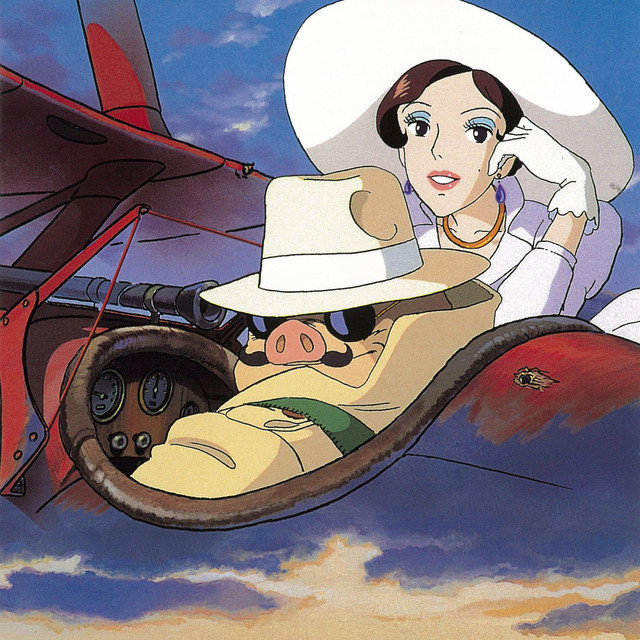
Album: 紅の豚 サウンドトラック
In the world of film music, few collaborations have proven as creatively fertile as that between composer Joe Hisaishi and director Hayao Miyazaki. Their partnership on Porco Rosso in 1992 represents a fascinating case study in how musical and narrative sensibilities can align through pure coincidence, creating something greater than the sum of its parts.
The story begins with an extraordinary stroke of fate. While Miyazaki was developing his tale of a World War I ace-turned-pig flying over the Adriatic Sea in 1930s Italy, Hisaishi was simultaneously working on a personal project called ‘My Lost City.’ This solo album, inspired by F. Scott Fitzgerald’s writings, explored the musical landscape of the 1920s Jazz Age. When the two artists discovered they were both drawn to the same historical period, Hisaishi later reflected that he felt ‘something very fateful as artists living in the same era.’
This serendipitous alignment would prove crucial to the soundtrack’s development. The 1920s were the height of the Jazz Age, when jazz music dominated cultural expression across Europe and America. For characters like Marco (Porco) and Gina, whose relationship forms the emotional core of the film, Hisaishi’s choice to express their themes through jazz piano wasn’t just aesthetically pleasing—it was historically accurate. The setting of a waterfront bar with its piano naturally called for this musical language, making the first appearance of their theme feel organic to the world Miyazaki had created.
When Hisaishi presented the completed ‘My Lost City’ album to Miyazaki, the director’s response was immediate and enthusiastic: ‘I want all of those songs, I want them all for Porco Rosso.’ This wasn’t mere politeness; Miyazaki genuinely heard connections between Hisaishi’s jazz-influenced compositions and his vision for the film. The opening track, ‘The Wind of the Era—When People Could Be People,’ was conceived with ‘My Lost City’s’ ‘1920~Age of Illusion’ in mind, while the scene of Porco’s seaplane taking off from the canal directly incorporated music from ‘Madness.’
To facilitate their collaboration, Miyazaki provided Hisaishi with six poems as creative inspiration: ‘Flying Boat Pilot’s Tango,’ ‘Ascension,’ ‘Twilight Adriatic Sea,’ ‘Night Flight,’ ‘Secret Garden,’ and ‘Merry-Go-Round.’ These verses served as emotional roadmaps, helping Hisaishi understand not just the visual elements of scenes, but their underlying feelings and atmosphere.
Listen to ‘Porco e Bella’ and you’ll hear how Hisaishi translated this poetic guidance into music. The track captures the bittersweet romance between Porco and Gina with a delicate piano melody that speaks to both intimacy and distance. The jazz harmonies reflect the era’s musical language, but Hisaishi’s orchestration adds layers of melancholy that speak to the characters’ complex history. It’s a piece that works both as period-appropriate source music and as emotional storytelling—exactly what the film needed.
‘Fio—Seventeen’ demonstrates another aspect of Hisaishi’s approach to the score. The young aircraft designer Fio represents youth, optimism, and technical innovation in a world overshadowed by war and cynicism. Hisaishi’s music for her character is lighter, more hopeful, with melodic lines that suggest both her mechanical precision and her spirited personality. The composition avoids the weightier jazz harmonies associated with the adult characters, instead using brighter orchestral colors that reflect her position as someone not yet marked by the world’s disappointments.
Perhaps most revealing is ‘Dog Fight,’ which accompanies the film’s climactic aerial battle. Here, Hisaishi faced a creative crossroads that would later cause him to reflect critically on his approach. The composer admitted years later that he sometimes found himself pulled toward writing action music when Miyazaki’s vision called for something more restrained. ‘Miyazaki’s personal feelings came through strongly in this film, and I should have held back more, but there were parts where I was tempted to lean into action-movie style. I still regret that.’
This self-criticism reveals something important about Hisaishi’s artistic philosophy and his evolution as Miyazaki’s collaborator. The composer recognized that Porco Rosso wasn’t primarily an adventure story—it was a deeply personal meditation on loss, aging, and the cost of war. The music needed to support this introspective quality rather than overwhelm it with conventional excitement.
The complete soundtrack, spanning twenty tracks, creates a musical journey through 1930s Europe that feels both historically grounded and emotionally resonant. Pieces like ‘The Adriatic Sea’ and ‘Sepia-Colored Photograph’ use orchestral textures and harmonic progressions that evoke the period’s musical sensibilities while serving the film’s narrative needs. The recurring motifs—particularly the jazz-influenced themes for the main characters—create musical continuity that mirrors the cyclical nature of memory and regret that drives the story.
What makes the Porco Rosso soundtrack particularly fascinating is how it documents Hisaishi’s growing understanding of his role in Miyazaki’s creative process. Rather than simply providing musical accompaniment, he learned to become a collaborator in the director’s exploration of complex themes. The jazz elements aren’t just period decoration; they’re integral to the film’s examination of a lost world and the people who survived its destruction.
The album stands as evidence of how creative accidents can lead to artistic breakthroughs. Without the coincidental alignment of Hisaishi’s solo jazz project and Miyazaki’s 1930s setting, the score might have taken an entirely different direction. Instead, we have a soundtrack that feels inevitable—music that seems inseparable from the images it accompanies, born from a moment when two artists discovered they were already walking the same creative path.
- 時代の風-人が人でいられた時-Read Review
- MAMMAIUTORead Review
- Addio!Read Review
- 帰らざる日々Read Review
- セピア色の写真Read Review
- セリビア行進曲Read Review
- Flying boatmenRead Review
- Doom-雲の罠-Read Review
- Porco e BellaRead Review
- Fio-SeventeenRead Review
- ピッコロの女たちRead Review
- FriendRead Review
- Partner shipRead Review
- アドリアの海へRead Review
- 遠き時代を求めてRead Review
- 荒野の一目惚れRead Review
- 夏の終わりにRead Review
- 失われた魂-LOST SPIRIT-Read Review
- Dog fightRead Review
- Porco e Bella-Ending-Read Review
Sources
- Porco Rosso Soundtrack LP Liner Notes (2020)
- I Am: The Way of Music / Porco Rosso Soundtrack Liner Notes
- I Am: The Way of Music (Joe Hisaishi)
- Porco Rosso Disc Notes
- NHK FM Joe Hisaishi Special Program