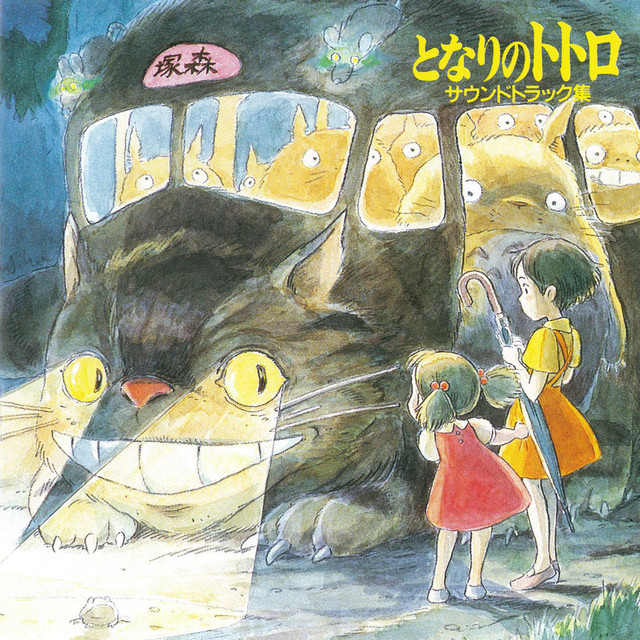
Album: となりのトトロ サウンドトラック集
What happens when a composer must capture the absence of a character through music? For Joe Hisaishi, creating ‘Mei ga Inai’ (Mei is Gone) from the My Neighbor Totoro soundtrack meant walking a delicate tightrope between childhood innocence and genuine emotional weight. This single track reveals the sophisticated musical philosophy that transformed what could have been ‘just another children’s film’ into something far more profound.
The challenge Hisaishi faced with Totoro was unique in his collaboration with Studio Ghibli. Unlike previous projects, this film centered on everyday moments rather than epic adventures. The story’s gentle pace and focus on daily life meant that instrumental pieces alone wouldn’t provide enough narrative clarity. As Hisaishi explains, the abundance of quotidian sequences required songs rather than purely orchestral pieces to sharpen each scene’s emotional focus.
‘Mei ga Inai’ emerges during one of the film’s most anxiety-inducing moments – when young Mei disappears, leaving her sister Satsuki desperately searching. Here, Hisaishi’s musical approach becomes crucial. The track operates in a minor key, with sparse instrumentation that creates space for worry to breathe. Rather than overwhelming the scene with dramatic orchestration, the composer allows silence and subtle musical phrases to amplify the emotional tension.
This restraint reflects Hisaishi’s broader philosophy for the Totoro soundtrack. He recognized that relying solely on traditional orchestral arrangements would reduce the film to what he called ‘an ordinary children’s movie.’ Instead, he deliberately incorporated ethnic and minimalist elements to prevent the music from falling into predictable patterns. The famous Totoro theme itself features minimalist repetitions and ethnic atmospheres that give the entire soundtrack its distinctive character.
The creation of ‘Mei ga Inai’ also benefited from an unusual shift in the collaboration process. For the first time, director Hayao Miyazaki took direct control of the musical meetings, stepping forward to lead discussions that had previously been dominated by producer Isao Takahata. This change brought fresh energy to the project, with Miyazaki jokingly complaining that ‘Takahata was being unfair’ by monopolizing the musical direction in their previous collaborations.
Hisaishi’s hands-on approach extended beyond composition into performance. He personally played the tabla drums that appear throughout the soundtrack, recording these ethnic percussion elements himself rather than relying on session musicians. This direct involvement allowed him to achieve precisely the atmospheric textures he envisioned, where ethnic instrumentation could coexist naturally with orchestral arrangements.
The recording process for ‘Mei ga Inai’ took place during a period when Hisaishi fell ill partway through production. Originally, he had planned for synthesizers to dominate the soundtrack, with orchestral elements playing a supporting role. However, his illness forced a reduction in synthesizer work, resulting in a final mix that was roughly 60% orchestra and 40% synthesizer – the reverse of his original intention.
This accidental shift proved fortunate for tracks like ‘Mei ga Inai.’ The increased orchestral presence gives the piece a warmth and organic quality that pure electronic arrangements might have lacked. The strings carry much of the emotional weight, while subtle electronic textures add an otherworldly quality that mirrors the film’s magical realism.
The track demonstrates Hisaishi’s mastery of what he calls ‘structural thinking’ in soundtrack composition. Rather than treating each piece as an isolated entity, he views the entire album as an interconnected system. ‘Mei ga Inai’ serves as an emotional counterpoint to the album’s main themes – ‘Sanpo’ (Stroll) and ‘Tonari no Totoro’ (My Neighbor Totoro) – while supporting what he termed the ‘hidden theme,’ ‘Kaze no Toorimichi’ (The Path of the Wind).
This systematic approach reflects Hisaishi’s background in minimalist and contemporary classical music. Unlike composers who rely primarily on melodic hooks or harmonic progressions, he thinks in terms of musical architecture. ‘Mei ga Inai’ occupies a specific structural position within this architecture, providing necessary emotional depth without overwhelming the film’s gentle tone.
The lasting impact of ‘Mei ga Inai’ lies in its emotional honesty. Rather than patronizing young audiences with overly simple musical language, Hisaishi trusts children to engage with complex feelings. The track acknowledges that even in the magical world of Totoro, real fears and genuine worries exist. This balance between wonder and reality becomes the secret ingredient that elevates the entire soundtrack above conventional children’s entertainment.
For European listeners familiar with contemporary classical music, ‘Mei ga Inai’ represents a fascinating fusion of Eastern and Western musical traditions. Hisaishi’s ability to incorporate minimalist techniques and ethnic elements while maintaining accessibility demonstrates why his work has found such broad international appeal. The track proves that film music can simultaneously serve narrative purposes and stand alone as compelling musical art.
- さんぽ-オープニング主題歌-Read Review
- 五月の村Read Review
- オバケやしき!Read Review
- メイとすすわたりRead Review
- 夕暮れの風Read Review
- こわくないRead Review
- おみまいにいこうRead Review
- おかあさんRead Review
- 小さなオバケRead Review
- トトロRead Review
- 塚森の大樹Read Review
- まいごRead Review
- 風のとおり道(インストゥルメンタンル)Read Review
- ずぶぬれオバケRead Review
- 月夜の飛行Read Review
- メイがいないNow Playing
- ねこバスRead Review
- よかったねRead Review
- となりのトトロ-エンディング主題歌-Read Review
- さんぽ(合唱つき)Read Review